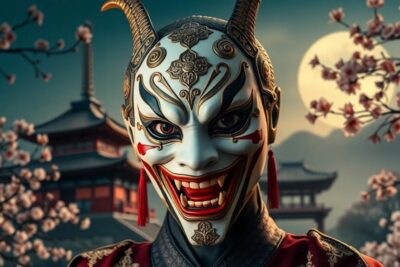
Japanese Mask Meanings: History, Symbolism, and Traditional Types
Japanese mask meaning depends on the figure represented and the setting in which the mask is used. A Hannya mask in Noh theater expresses a very different idea from an Oni mask worn during Setsubun or a metal menpo attached to samurai armor. Traditional Japanese masks can represent deities, spirits, demons, humans, animals, emotions, social roles, or protective power.
This guide explains the best-known Japanese masks and meanings while distinguishing theater masks, festival masks, folklore figures, and warrior facial armor. For a broader comparison, explore our guide to famous masks from different cultures. It also shows why familiar designs such as Oni, Tengu, Kitsune, and Hannya cannot be reduced to a single label such as “good,” “evil,” or “lucky.”
Common Japanese mask types, names, and meanings:
| Japanese Mask Name | Common Meaning | Traditional Context |
|---|---|---|
| Oni | Danger, punishment, fear, and protection in some contexts | Folklore, Setsubun, festivals, theater |
| Tengu | Pride, dangerous power, martial skill, discipline, and protection in some contexts | Mountain folklore, religion, festivals |
| Kitsune | Intelligence, transformation, mystery, and divine service | Shinto associations, festivals, folklore |
| Hannya | Jealousy, grief, rage, and demonic transformation | Noh theater |
| Hyottoko | Comedy, fire tending, and festive good fortune | Folk dance and festivals |
| Okame or Otafuku | Joy, good fortune, warmth, and comic beauty | Festivals and folk performance |
| Menpo | Protection, intimidation, and warrior identity | Samurai armor |
| Namahage | Discipline, protection, and seasonal blessing | New Year ritual in the Oga Peninsula |
The Origin and History of Japanese Masks
From Ritual and Theater to Festivals and Armor
The history of masks in Japan does not follow one continuous tradition. Different types developed for religious rites, court entertainment, popular festivals, classical theater, and warfare. Early masked performance traditions included Gigaku and Bugaku, which predated the later development of Noh. Over time, regional customs also produced masks representing local deities, animals, supernatural beings, and comic characters.
Noh masks developed into one of Japan’s most highly formalized mask traditions from the fourteenth century onward. This theater combines drama, chant, music, dance, costume, and controlled movement. Its companion form, Kyogen, uses spoken comedy and includes masks for selected roles, especially nonhuman or exaggerated characters. Festival and folk traditions developed separately and vary widely in style, purpose, and performance setting.
Across Japanese culture, masks have served different functions depending on the tradition. Some festival masks temporarily turn participants into demons, fox spirits, visiting gods, or comic figures. Others help communities mark seasonal transitions, drive away misfortune, teach proper behavior, or invite a good harvest. Samurai facial armor followed a separate path: metal face guards protected parts of the face, helped secure the helmet, and contributed to the wearer’s martial appearance.
Omote and the Meaning of Masks in Noh
The Japanese word for mask is kamen (仮面). Noh masks are also called noh-men, and performers traditionally refer to them respectfully as omote, or “face.”
A Noh mask does not merely hide the actor. Its carved features provide a controlled emotional framework that the performer activates through posture, movement, lighting, and angle. A small tilt can alter how the mouth, eyes, and shadows are perceived, allowing one carved face to suggest several emotional states without changing masks.
How Japanese Masks Are Made
Traditional Materials and Carving
Traditional Noh masks are usually carved from lightweight wood, especially Japanese cypress, or hinoki. The maker begins with a solid block, establishes the front profile, hollows the back, and gradually refines the eyes, mouth, cheeks, and nose. The back is hollowed for wear and fitted with cord holes; the inner surface may also be lacquered to help protect the wood from moisture.
Other Japanese mask types use different materials according to function. Festival masks may be made from wood, papier-mâché, paper, clay, resin, or other molded materials. Samurai face armor is made from metal and may include lacquer, cords, hair, and detachable components.
Paint and Symbolism
Traditional Noh masks may be coated with gofun, a white preparation made from powdered shell mixed with binder, before details are added with pigments. Color does not create one universal Japanese mask code: red, white, black, gold, blue, and green can mean different things in Noh, Kabuki makeup, Buddhist imagery, festival costume, modern art, or commercial reproductions. Accurate interpretation begins with the mask type and its cultural context, not color alone.
Tengu Mask Meaning
A Tengu mask represents a powerful mountain being associated with danger, pride, martial skill, religious discipline, and, in some later contexts, protection. Tengu belong to the broad world of yōkai, a term for strange, supernatural, or difficult-to-classify beings in Japanese folklore.
What the Long Nose Symbolizes
The best-known Tengu mask has a red face, fierce brows, and an extremely long nose. Earlier birdlike forms, often called Karasu Tengu, have beaks, wings, or avian features. The human-faced long-nosed form is commonly associated with Daitengu, or “great Tengu.”
The long nose is often interpreted as a sign of pride or arrogance. In Japanese, describing someone as “becoming a Tengu” can suggest that praise has made the person conceited. The feature may also signal supernatural identity and separation from ordinary humans, but it should not be treated as a universal symbol of wisdom or the ability to detect lies.
From Dangerous Yōkai to Protective Figure
Tengu were not originally simple guardians of nature. Medieval stories often portrayed them as disruptive beings who misled monks, challenged Buddhist authority, caused disorder, or punished excessive pride. Other legends connected them with mountain ascetics and exceptional swordsmanship.
Their meaning changed across periods and communities. A Tengu may appear as a dangerous adversary, a stern teacher, a protector of a mountain site, or an emblem of disciplined martial power. This ambiguity explains why modern Tengu masks can communicate both threat and protection without either meaning fully replacing the other.
Oni Mask Meaning
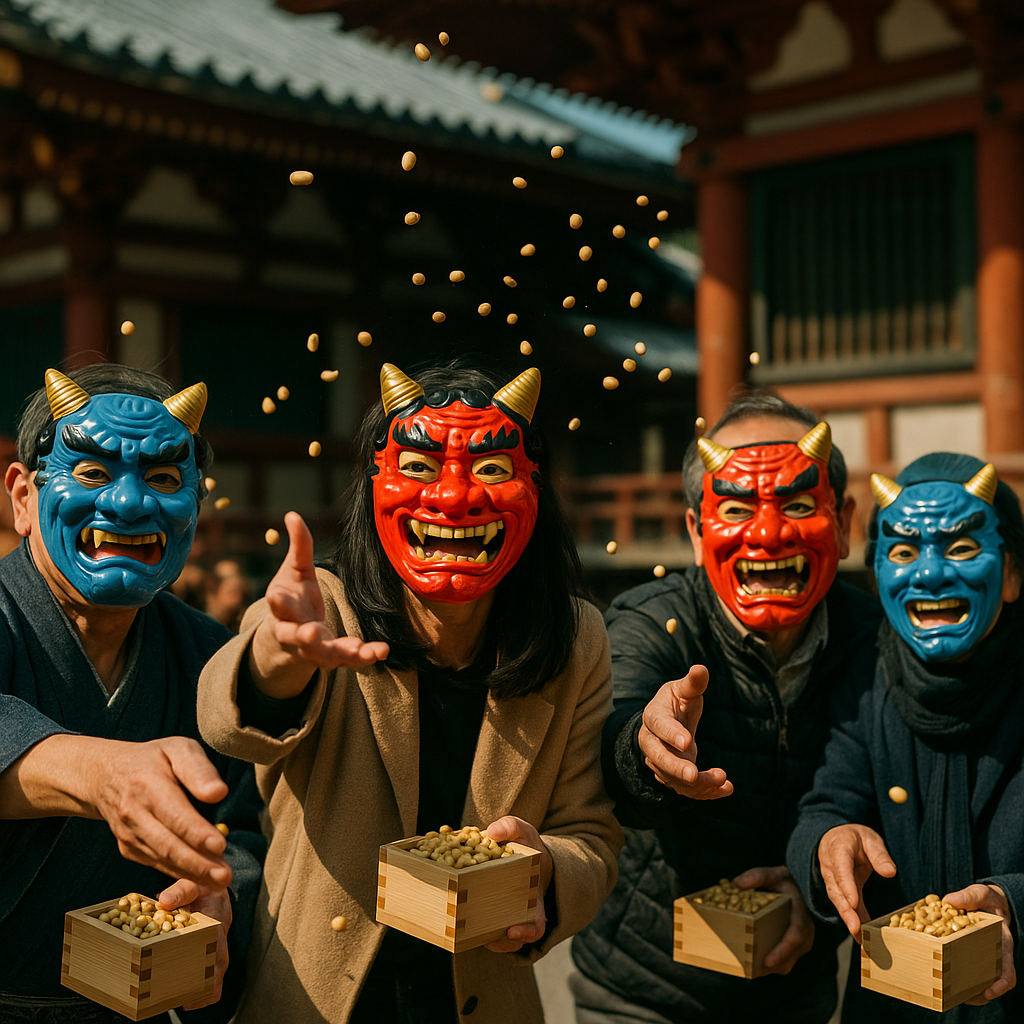
An Oni mask represents a fearsome supernatural being commonly translated as a demon or ogre. Oni are recognized by horns, fangs, glaring eyes, wild hair, and powerful bodies. Their basic associations include danger, punishment, uncontrolled force, illness, and fear, yet in some religious and festival traditions an Oni figure can also take on a protective or exorcistic role.
There is no single Japanese “demon mask.” Oni masks depict supernatural ogre-like beings from folklore and religious tradition, while Hannya is a specific Noh mask representing a woman transformed by jealousy, rage, and suffering. Other fierce masks, including some Tengu and Noh types, belong to different traditions and should not all be grouped under one label.
Evil, Punishment, and Protection
In folktales and religious imagery, Oni may torment wrongdoers, guard the realms of the dead, spread disaster, or personify destructive impulses. In some ritual contexts, however, a fearsome Oni figure can be used to confront or repel harmful forces rather than represent evil alone.
This is why Oni mask meaning is not limited to “evil.” Depending on the tradition, the image can represent a threat, punishment for wrongdoing, or a force used symbolically against danger.
Oni Masks in Setsubun and Japanese Festivals
Oni masks are especially visible during Setsubun, a seasonal observance held in early February. During mamemaki, or bean throwing, participants cast roasted soybeans while saying, “Oni wa soto! Fuku wa uchi!”—“Demons out! Good fortune in!” In homes, schools, temples, and public events, one participant may wear an Oni mask so the symbolic threat can be driven away.
Setsubun therefore gives the Oni a ritual role: it becomes a visible form of misfortune that the community can identify and expel.
Do Oni Mask Colors Have Fixed Meanings?
Searches for red, blue, green, black, and white Oni mask meaning often assume that every color has one fixed definition. It does not. Some Buddhist and Setsubun teaching traditions connect differently colored Oni with particular mental obstacles or harmful desires, while festivals, theater, tattoos, games, and decorative masks may use color in other ways.
Red and blue are especially common visual contrasts, but their meaning should be explained from the specific tradition or artwork rather than from a universal color chart. Oni designs also vary across regions, festivals, theater, and religious settings, so there is no single universal list of “Oni mask types” that applies to every context.
Kitsune Mask Meaning
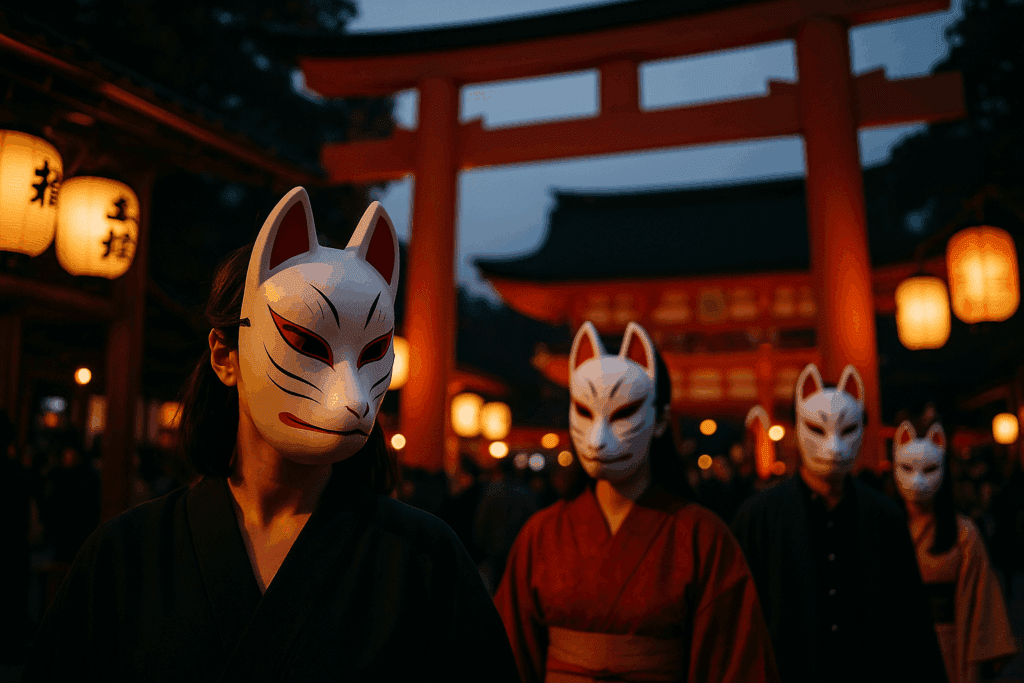
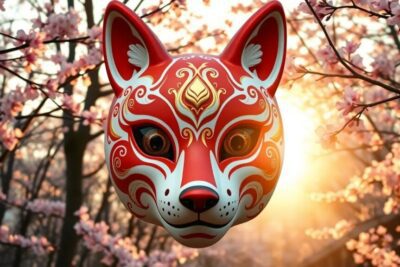
A Kitsune mask represents a fox, but its meaning can include intelligence, transformation, ambiguity, spiritual power, deception, loyalty, or good fortune. In Japanese folklore, foxes may be ordinary animals, supernatural shape-shifters, or beings connected with sacred places.
Fox Spirits, Inari, and Shinto Associations
Kitsune are closely associated with Inari, a Shinto deity connected with rice, agriculture, prosperity, and later business success. Foxes at Inari shrines are generally understood as the deity’s messengers or attendants, not as Inari itself. This distinction matters because modern summaries often incorrectly call every fox an “Inari god.”
Folklore also describes foxes capable of assuming human form. These stories range from dangerous deception to marriage, gratitude, love, and protection. As a result, Japanese fox mask meaning is deliberately unstable: the wearer may suggest a divine messenger, a clever trickster, a hidden identity, or a being moving between human and supernatural worlds.
Kitsune Mask Colors and Markings
White Kitsune masks with red or black painted details are common at festivals and in contemporary design. Pointed ears, narrow eyes, whisker lines, and stylized brows make the fox identity immediately recognizable. However, these colors and markings do not form a single traditional code shared by all shrines, regions, artists, anime, and commercial masks.
Hannya Mask Meaning
A Hannya mask represents a woman transformed into a demonlike being by overwhelming jealousy, resentment, grief, and rage. It is one of the most recognizable Noh masks because its horns, metallic eyes, sharp teeth, and tense expression combine emotional suffering with supernatural danger.
Jealousy, Grief, Rage, and Transformation
Hannya is not simply a generic “female demon.” The mask expresses a dramatic process in which attachment and emotional pain consume a human character. In Noh plays such as Aoi no Ue and Dōjōji, the audience is asked to recognize both the destructive force of the transformed woman and the suffering that produced it.
That duality separates Hannya from a basic monster mask. The horns and fangs communicate threat, but the eyes and facial structure can retain traces of anguish. Depending on the play and mask, color and modeling may suggest differences in character, status, or emotional intensity. These variations should not be reduced to a universal chart in which white, red, or dark Hannya masks always have one exact meaning.
How Viewing Angle Changes the Expression
Noh performers control the mask’s apparent expression through subtle movement. Tilting the face slightly upward is known as terasu, literally “to illuminate,” and can make a mask appear brighter or more open. Tilting it downward is called kumorasu, “to cloud,” and can deepen shadows around the eyes and mouth, creating a sadder or darker impression.
With Hannya, a change in angle can alter which features dominate the viewer’s perception. From one angle the mouth and fangs stand out; from another, the lowered face can seem grief-stricken. The carving does not physically change; the performer changes the relationship among the mask, stage light, and audience.
Hyottoko Mask Meaning
A Hyottoko mask depicts a comic male figure with a twisted or puckered mouth, uneven eyes, and a cloth tied around the head. Its expression is intentionally awkward and often appears in folk dances, festival performances, and humorous scenes.
Comedy, Fire, and Festival Performance
The puckered mouth is commonly associated with blowing through a bamboo tube to tend a fire. One explanation connects the name Hyottoko with hi-otoko, or “fire man,” although the figure has accumulated several regional stories and interpretations.
Hyottoko communicates humor through asymmetry rather than polished beauty. The character may act foolishly or dance clumsily, and because he often appears at celebrations the mask can also be associated with festive good fortune. It is more accurate to describe Hyottoko as a comic festival figure with fire associations than as a universal god of wealth.
Okame and Otafuku Mask Meaning
Okame and Otafuku masks show a smiling woman with rounded cheeks, a small nose and mouth, and narrow eyes. The names are often used for closely related comic female faces, although their histories and associations are not identical in every context.
Joy, Good Fortune, and Comic Tradition
The mask generally represents cheerfulness, warmth, humility, and good fortune. Its rounded features contrast with the sharp lines of Oni, Tengu, and Hannya masks, creating a welcoming and humorous presence rather than one centered on threat or supernatural danger.
Okame is linked in popular tradition with the comic figure Ame-no-Uzume, whose dance in Japanese mythology helped draw the sun goddess Amaterasu from a cave. The identification is not exact in every context, but it contributed to associations with laughter and performance. Okame and Hyottoko are also often paired in dances and festival imagery as familiar comic figures.
Menpo and Samurai Mask Meaning
Menpo, also spelled mempo, is facial armor worn with a Japanese helmet. Unlike theatrical or festival masks, samurai face guards were defensive equipment. Their meaning comes from the combination of practical protection, military presentation, craftsmanship, and the fearsome identity created by an armored face.
Why Samurai Wore Facial Armor
Menpo protected part of the face and provided an anchoring point for the helmet’s cords. Many were fitted with an attached throat guard. Some were shaped with prominent noses, wrinkles, teeth, or detachable mustaches, making the wearer appear older, fiercer, or less human.
These features could increase intimidation, but menpo should not be described only as psychological warfare. Armorers also had to balance coverage, visibility, breathing, comfort, and compatibility with the helmet. The mask was part of a complete armor system rather than an independent symbol.
Types of Samurai Face Masks: Menpo, Somen, Hanbo, and Happuri
Japanese samurai mask types are often distinguished by how much of the face they cover:
- Somen: a full-face mask covering most or all of the face.
- Menpo or mempo: a half-mask generally covering the nose, cheeks, and chin.
- Hanbo: a lower-face guard protecting the chin and jaw, usually without a nose section.
- Happuri: an upper-face guard protecting the forehead and cheeks while leaving much of the central face exposed.
Individual examples vary considerably. Some are plain and functional; others resemble old men, demons, or supernatural beings. A Tengu-shaped somen, for example, combines military armor with a recognizable folklore face.
Other Traditional Japanese Masks and Their Meanings
Obeshimi Mask Meaning
Obeshimi, also written Ōbeshimi, is a fierce Noh mask characterized by bulging eyes, a broad nose, tense facial muscles, and a tightly compressed mouth. It belongs to the broader Beshimi family, whose closed lips and forceful expressions suggest contained supernatural energy.
Obeshimi is used for powerful nonhuman roles, including demonic beings. Its meaning is not simply “evil”: the mask can communicate violent strength, resistance, anger, or formidable supernatural presence. The tightly closed mouth is central to its expression, suggesting force held under pressure rather than released in an open snarl.
Noh and Onna-men Masks
“Noh mask” is not the name of one design. Among traditional theater masks, Noh has one of the most highly developed systems, with mask types for women, old men, warriors, deities, ghosts, animals, and demons. Onna-men means female masks and includes different faces for age, social identity, temperament, and dramatic role.
Ko-omote is a well-known young-woman mask associated with youth and restrained beauty. Other female masks can suggest maturity, sorrow, jealousy, nobility, or supernatural transformation. Their differences may be subtle, so meaning comes from the mask’s classification, costume, role, and performance rather than from one feature alone.
Namahage Masks
Namahage masks belong to a New Year tradition from the Oga Peninsula in Akita Prefecture. Participants dress in straw garments and fierce red or blue masks and visit homes, loudly asking whether children have been disobedient or whether household members have been lazy.
Despite their frightening appearance, Namahage are understood locally as visiting deities who warn against laziness and bring protection from illness and disaster, good harvests, and abundant food. The mask therefore combines discipline, fear, blessing, and community renewal. Namahage should not be classified as ordinary Oni, even though modern viewers may notice visual similarities.
Kabuki Masks vs. Kumadori Makeup
Searches for Kabuki mask meaning often lead to a common misunderstanding: Kabuki actors usually rely on makeup rather than a mask system comparable to Noh. One famous style is kumadori, in which bold painted lines emphasize muscles, emotion, and character type.
In traditional Kabuki conventions, red kumadori can indicate youth, justice, anger, or heroic strength; indigo can mark a villain or evil spirit; and brown may be used for supernatural demons or ghosts. These are Kabuki makeup conventions, not universal Japanese mask color meanings. Masks may appear in specific productions, but “types of Kabuki masks” should not be treated as a standard category equal to Noh masks.
What Japanese Masks Mean Today
Festivals, Performance, Art, and Pop Culture
Traditional Japanese masks remain active in Noh, Kyogen, regional dances, seasonal rites, and local festivals. Oni, Hannya, Kitsune, and Tengu faces also appear in tattoos, anime, manga, video games, fashion, and contemporary art.
These modern uses often personalize older meanings. A Hannya tattoo may represent emotional conflict, an Oni image may suggest protection, and a Kitsune mask may signal secrecy or transformation. Such readings are modern interpretations rather than universal traditional definitions.
Traditional Mask or Modern Reproduction?
An antique theatrical mask, a contemporary hand-carved mask, a festival souvenir, and a resin cosplay mask may depict the same figure while serving very different purposes. Materials, age, maker, origin, and documented performance or ritual use affect how the object should be interpreted, so a modern reproduction should not automatically be assigned the same cultural function as a historical or ceremonial mask.
Hannya Mask Meaning: Symbolism, Colors, and Cultural Legacy
Traditional Indian Masks: Meanings, Rituals & Traditions
The History and Symbolism of Masks in Ancient Greek Theatre
Death Masks: History, Purpose, and Famous Examples
Kitsune Mask Meaning, History, and Symbolism in Japan
Scold’s Bridle: History, Use & How the Punishment Worked
Explore More Mask Stories 👇