Topeng Dance: History, Masks, Meaning, and Traditions
Quick answer: Topeng is an Indonesian masked dance-drama tradition in which performers use carved masks, movement, costume, and music—often including gamelan—to portray distinct characters and tell historical, legendary, or moral stories. It is not one standardized dance practiced identically across Indonesia; different regional traditions developed their own characters, performance styles, and ritual roles.
Major forms are found in Bali and in Java, especially Cirebon, where Topeng can function in ceremonial contexts, community performance, storytelling, and public entertainment. For a broader view of how masking traditions developed across different cultures and periods, explore our guide to the history of masks.
What Does Topeng Mean?
In Indonesian, topeng means “mask,” while tari means “dance,” so tari topeng is commonly translated as “mask dance.” In practice, however, the term refers to more than dancing while wearing a mask. It can describe forms of masked dance-drama in which performers combine movement, costume, music, characterization, and sometimes spoken dialogue to present stories or ceremonial roles.
The term is used across several Indonesian regions, but it does not identify one uniform performance tradition. Balinese Topeng, Cirebonese Topeng in West Java, Betawi Topeng around Jakarta, and mask traditions in East Java developed within different linguistic, religious, and theatrical settings. Their masks, characters, stories, musical accompaniment, and performance structures can therefore differ substantially even though they share the broad idea of masked performance.
The History of Topeng Dance
Early Evidence of Masked Performance in Java
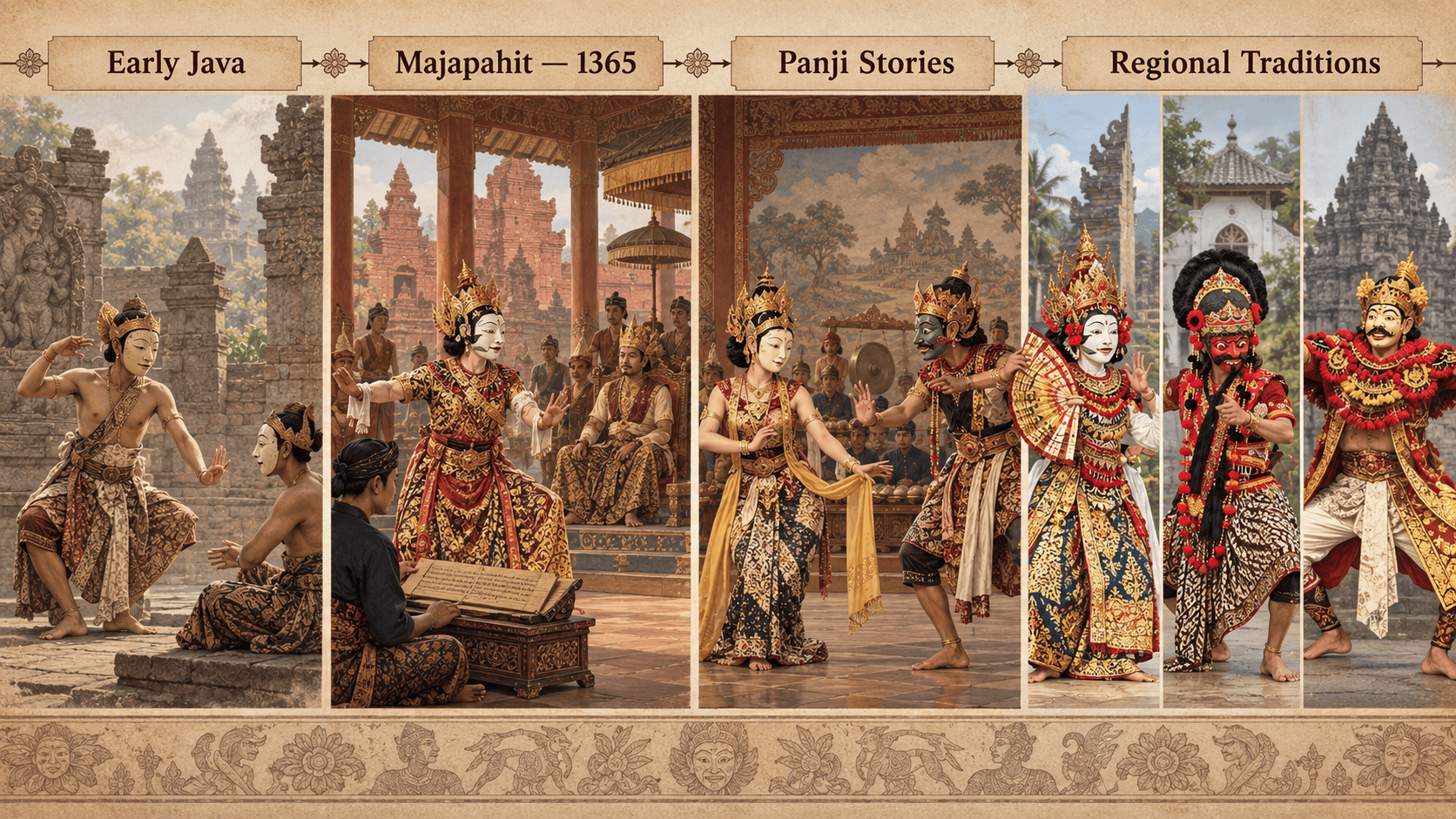
The history of Topeng does not begin with a single documented “invention.” Instead, the tradition developed within a much older culture of masked performance in Java and other parts of Indonesia. Early inscriptions and court records indicate that masked performers were already present in Java centuries before the regional Topeng traditions known today took their later forms. These references show that masks had established roles in performance, ceremony, and court culture, but they do not provide enough detail to reconstruct exactly how those performances looked.
For that reason, ancient references to masked dancing should not be treated as direct descriptions of modern Balinese, Cirebonese, or East Javanese Topeng. The evidence supports continuity in the broader practice of masked performance, not a single unchanged dance preserved intact across many centuries.
The Nāgarakṛtāgama and Majapahit in 1365
One of the most important written sources is the Nāgarakṛtāgama, a Javanese court poem completed in 1365 during the Majapahit period. The text describes the royal world of King Hayam Wuruk and includes references to masked performance at court. This evidence is significant because it places masked theatrical activity within the highly developed ceremonial and artistic culture of 14th-century Java.
Majapahit became an important political and cultural center in the Indonesian archipelago, and later traditions often looked back to this period as part of a prestigious historical past. However, the 1365 reference should be used carefully: it confirms the presence of masked performance in Majapahit court culture, but it does not prove that the choreography, masks, characters, or performance structure were identical to later Topeng forms.
Panji Stories and the Development of Topeng Traditions
Panji stories became especially important in the development of Javanese masked dance-drama. These narratives center on Prince Panji and related royal characters, combining romance, separation, conflict, disguise, and reunion. Over time, Panji cycles spread widely across Java and other parts of Southeast Asia and became closely associated with several Topeng traditions, particularly in Cirebon and East Java.
As these narrative traditions were adopted in different communities, they developed into regional forms with their own masks, movement vocabularies, music, languages, and performance conventions. Panji thus became an important thread connecting several Topeng traditions without making them culturally or theatrically identical.
How Does Topeng Dance Work?
Masks, Movement, and Character
In Topeng, the mask is not simply a decorative object; it helps define the character the performer must embody. A dancer changes posture, gesture, tempo, and energy according to the role represented by the mask. In Balinese Topeng, for example, a character such as Topeng Tua, the old man, is often performed with slower, more measured movement, while Topeng Keras, a forceful or “strong” character, uses firmer and more assertive physical vocabulary.
Costume reinforces the same transformation. Clothing, headdress, mask design, and movement work together so that the audience can recognize differences in age, status, temperament, or dramatic function. Because regional traditions vary, these character systems should not be treated as universal rules for every form of Topeng in Indonesia. For a broader comparison with other theater masks and masked performance traditions, see our dedicated guide.
Gamelan, Dialogue, and Storytelling
Topeng performances are usually supported by traditional musical accompaniment, often gamelan in Bali and Java. The music does more than provide rhythm: changes in tempo, dynamics, and melodic pattern can help mark entrances, emotional shifts, comic passages, or transitions between characters.
Storytelling may combine dance, gesture, spoken dialogue, narration, and humor. Historical chronicles, local legends, and Panji-related stories can provide the dramatic framework, while performers adapt delivery to the expectations of a particular community or performance setting.
Speaking and Non-Speaking Characters
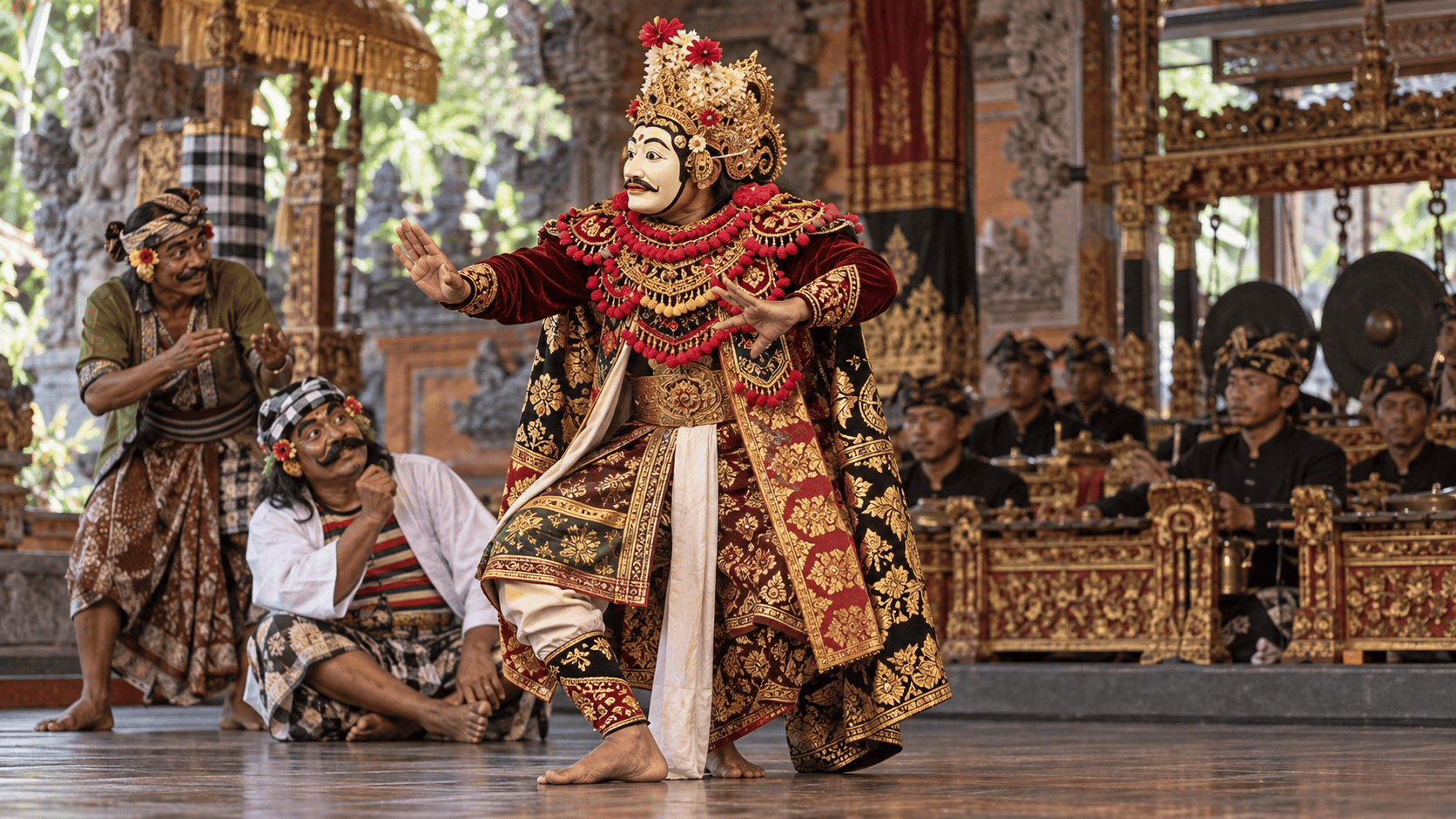
Not every masked character speaks. Full masks can restrict speech, so some roles communicate primarily through movement and are interpreted or connected to the story by speaking characters. In Balinese performance, Penasar often serves as a narrator, interpreter, or intermediary who helps explain events and make courtly or historical material understandable to the audience.
Comic figures known as Bondres may also speak directly, using humor, improvisation, and everyday language to comment on the story or contemporary life. This contrast between silent masked roles and verbal characters gives Topeng a layered dramatic structure in which movement, music, narration, and comedy work together.
Sacred, Ceremonial, and Entertainment Functions
Topeng in Ritual Contexts
The function of Topeng varies by region, community, and performance type. In some Balinese ceremonial contexts, particular masks are treated as sacred objects rather than ordinary stage props. They may be kept in temples or special storage, handled according to local custom, and approached with prayers or offerings before performance. These practices reflect the ritual status of specific masks and roles, not a universal rule applying to every Topeng tradition in Indonesia.
One important Balinese example is Topeng Sidakarya, a ceremonial role associated with the successful completion of certain religious ceremonies. The appearance of Sidakarya can mark the ritual fulfillment of the event, linking masked performance directly to religious and communal obligations. Its function is therefore different from that of a purely theatrical character performed for entertainment.
From Temple and Community Performance to the Modern Stage
Topeng also exists outside strictly sacred settings. Performances may be presented at community celebrations, cultural festivals, schools, theaters, and commercial venues. In Bali, ritual forms continue alongside staged versions created for broader audiences, while regional traditions elsewhere in Indonesia may emphasize storytelling, local identity, humor, or public entertainment.
Modern performance has also become an important tool for cultural preservation. Dancers, musicians, mask makers, and teachers transmit repertoire through training, workshops, festivals, and educational programs. Tourism and commercial stages can provide visibility and economic support, although the meaning of a performance depends on its setting: a temple ceremony, community event, and tourist presentation may use related artistic forms while serving very different purposes.
Major Regional Traditions of Topeng Dance
Balinese Topeng
Balinese Topeng developed into several performance forms with different numbers of actors and different relationships to ritual, storytelling, and entertainment. Topeng Pajegan is traditionally performed by a single dancer who changes masks to portray multiple characters, requiring rapid shifts in movement, posture, voice, and dramatic personality. Topeng Panca expands the format to several performers, allowing roles to be distributed among a small ensemble.
Topeng Prembon combines elements of Topeng with other Balinese dramatic traditions and may incorporate both masked and unmasked roles. Bondres characters, meanwhile, are comic figures who often speak in everyday language, improvise, and connect historical or courtly stories with the concerns of contemporary audiences. These categories describe important Balinese practices, but individual performances can vary according to community, lineage, and ceremonial setting.
Cirebon Topeng in West Java
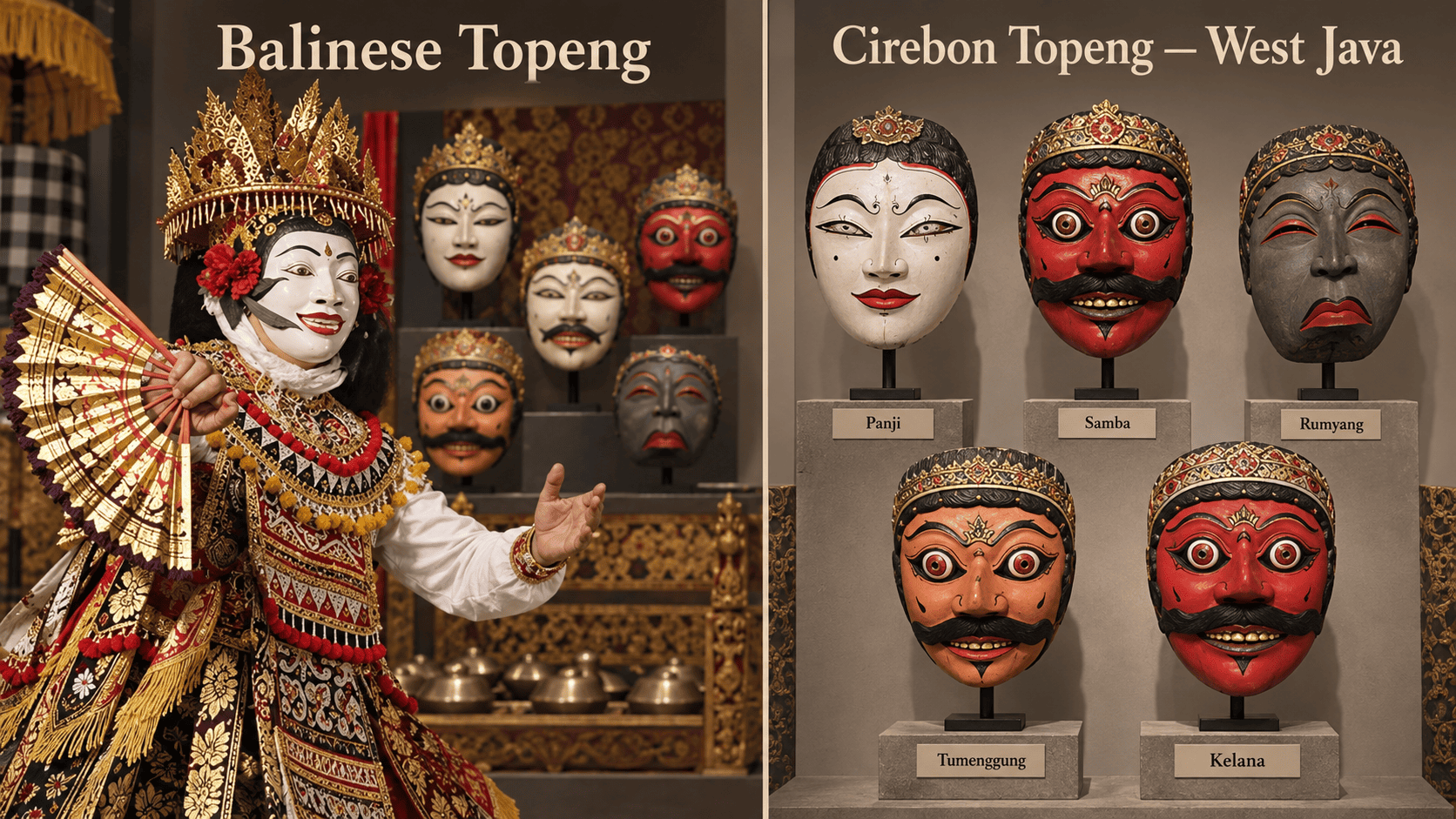
Cirebon Topeng in West Java developed a distinct character system closely associated with Panji narratives. Five principal masks are commonly identified in contemporary Cirebonese tradition: Panji, Samba, Rumyang, Tumenggung, and Kelana. Rather than functioning simply as different decorative faces, they represent contrasting stages, personalities, and dramatic qualities.
Panji is generally associated with refinement, restraint, and an inward quality, while Samba is more youthful and lively. Rumyang presents another refined but more active character, and Tumenggung conveys authority and strength. Kelana, with forceful movement and a more aggressive dramatic presence, often represents uncontrolled desire, ambition, or power. The sequence and interpretation of these masks can vary among local styles and hereditary performance lineages.
Betawi, Malang, and Other Regional Forms
Topeng traditions also developed beyond Bali and Cirebon. Betawi Topeng around Jakarta combines masked dance, music, dialogue, comedy, and community theater, reflecting the cultural mixture of the Betawi region. In East Java, Malangan Topeng developed around Panji-related narratives and a distinctive repertory of carved masks, dance vocabulary, and ensemble performance.
Other regional forms exist across Java and elsewhere in Indonesia, each shaped by local languages, musical systems, ritual practices, and storytelling traditions.
What Do Topeng Masks Represent?
Character, Personality, and Social Role
Topeng masks help audiences distinguish characters by age, status, temperament, and dramatic role. Depending on the regional tradition, a mask may identify a ruler, refined hero, warrior, elderly figure, commoner, comic character, or antagonist. Its facial proportions, expression, carving, and surface treatment contribute to that characterization.
These distinctions also reflect the social world represented onstage. Refined courtly figures may be visually separated from forceful warriors, comic servants, or ordinary villagers, allowing audiences to recognize differences in authority and personality before a character speaks—or even when the character remains silent. The exact visual conventions vary among regional Topeng traditions and performance lineages.
Color and Expression: Why Meanings Depend on Tradition
Color can contribute to character identification, but there is no single color-symbolism chart that applies to every Topeng tradition in Indonesia. White, red, black, and other colors may carry different associations depending on region, character, lineage, and performance context. A color used for a refined figure in one tradition should not automatically be given the same meaning in another.
For this reason, Topeng masks should be interpreted as part of specific regional character systems rather than through universal formulas such as “white means purity” or “red means anger.” Facial shape, carving style, color, costume, movement, and story work together to define the character the audience sees.
Topeng Dance Today: Preservation and Cultural Change
Topeng remains a living performance tradition rather than a historical form preserved only in museums. In Bali, Cirebon, East Java, Jakarta, and other regions, performers continue to present Topeng in ritual settings, community celebrations, cultural festivals, and staged productions. Some ceremonial forms retain strong religious or communal functions, while others are adapted for theaters, schools, tourism, and broader public audiences.
Transmission is central to its survival. Dancers, musicians, mask carvers, teachers, and family or community lineages pass on movement vocabularies, character systems, stories, musical accompaniment, and craft techniques to younger generations. Cultural institutions and festivals also help document and present regional traditions to new audiences.
Modern adaptations inevitably change performance length, staging, audience expectations, and presentation, but they do not erase Topeng’s regional identities. Its continued vitality depends on balancing innovation with the knowledge, ritual practices, and artistic conventions that give each tradition its historical and cultural meaning within Indonesia.
History of Halloween Masks: Origins to Modern Horror

Theater Masks: History, Meaning, and Comedy & Tragedy Symbols
The Cultural History and Evolution of Dance Masks
The Fascinating World of Masks: History, Culture, and Significance
History of Venetian Masks: Origins, Carnival, and Tradition
History of Chinese Masks: Origins, Types & Meanings
Explore More Mask Stories 👇