
History of Halloween Masks: Origins to Modern Horror
Halloween masks did not originate at a single documented moment. Their history developed from older European traditions of seasonal disguise, beliefs about spirits and the dead, medieval customs such as guising, and the later transformation of Halloween in the United States. What began as various forms of costume and concealment eventually became homemade Halloween disguises, commercially produced paper and plastic masks, licensed characters, and the realistic horror masks familiar today.
Following that evolution shows how Halloween masks changed from part of broader ritual and community traditions into one of the most recognizable elements of modern Halloween culture. For a broader view of how masks developed across different periods and cultures, explore our guide to the history of masks.
Halloween Masks Through History
| Period | Typical Disguise or Mask | Main Role |
|---|---|---|
| Ancient and early medieval traditions | Seasonal costumes and disguises | Beliefs about spirits, transformation, and seasonal rites |
| Medieval and early modern Europe | Guising, mumming, and other disguises | Performance, anonymity, and door-to-door customs |
| 19th-century America | Homemade costumes and simple face coverings | Parties, pranks, and community celebrations |
| Early 20th century | Paper, papier-mâché, fabric, and commercial masks | Affordable Halloween entertainment |
| Mid-20th century | Plastic and licensed character masks | Mass-market children’s costumes and pop culture |
| Late 20th century | Latex masks and horror characters | Greater realism and movie-inspired costumes |
| Today | Latex, silicone, custom, and digitally fabricated masks | Realism, fandom, collecting, and personalization |
Why Do We Wear Masks on Halloween?
The reasons people wear masks on Halloween have changed dramatically over time. Older traditions of disguise were connected with seasonal celebrations, supernatural beliefs, anonymity, and community performance. Later, disguises became part of door-to-door customs, parties, pranks, and entertainment.
In modern Halloween celebrations, masks allow wearers to temporarily become someone—or something—else. A mask can hide identity, create a frightening appearance, represent a fictional character, or complete a humorous costume. That sense of transformation connects modern Halloween masking with a much older tradition of using disguise to cross ordinary boundaries of identity and behavior, even though the meanings and circumstances have changed considerably over the centuries.
Samhain and the Early Roots of Halloween Disguise
The history of Halloween is often connected with Samhain, a Gaelic seasonal festival marking the transition from the harvest period toward winter. Samhain is an important part of Halloween’s historical background, but it is misleading to imagine a standardized “Halloween mask” already existing two thousand years ago. The evidence points more broadly to traditions of costume, disguise, supernatural belief, and seasonal ritual that later contributed to Halloween culture.
Spirits, the Dead, and Protective Disguises
Samhain was associated in later Irish tradition with a time when supernatural beings and the human world could interact more freely. Stories surrounding the festival include encounters with spirits, fairies, and otherworldly beings. Disguise and costuming became associated with this supernatural atmosphere, although the precise appearance and purpose of early costumes are not always documented in enough detail to reconstruct them with certainty.
Later accounts and historical interpretations connect disguising with attempts to imitate, avoid, or confuse supernatural beings. This helps explain why frightening and otherworldly figures eventually became so closely associated with Halloween, but these practices should be understood as part of a long cultural development rather than as identical versions of modern mask-wearing.
What Did Early Halloween Disguises Actually Look Like?
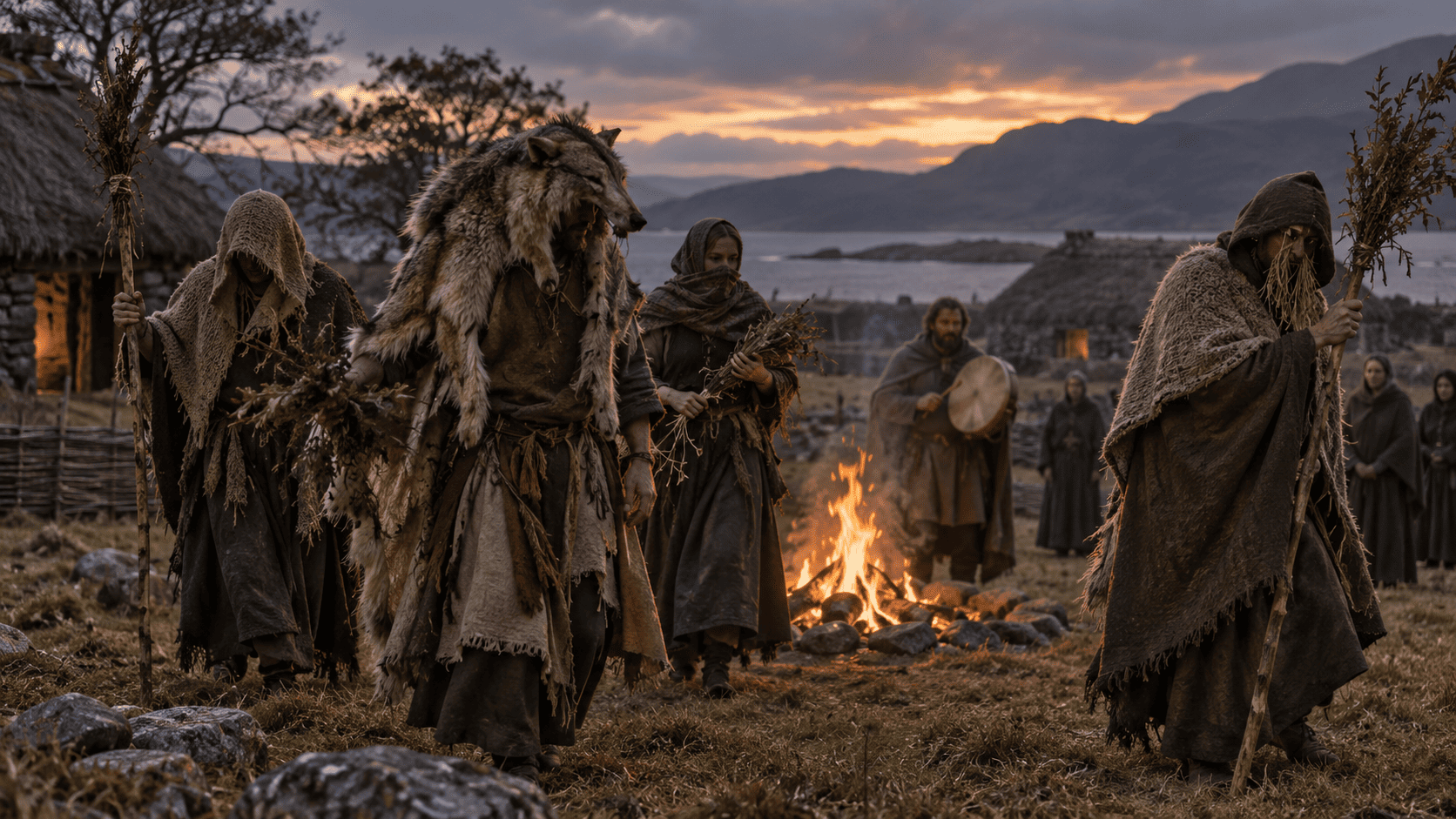
The exact appearance of early Samhain-related disguises is not securely documented. Costumes may have incorporated available clothing, animal imagery, altered faces, or other forms of disguise, but the surviving evidence does not allow a precise reconstruction.
What matters for the later history of Halloween masks is the broader principle: seasonal disguise already existed before commercial Halloween products. Over time, European customs gave that practice new religious, social, and theatrical meanings.
From All Hallows’ Eve to Guising and Souling
Halloween did not develop from Samhain alone. Christian feast days and local European customs also helped shape the calendar, imagery, and practices surrounding the end of October and beginning of November.
Christian Influence on Halloween
All Saints’ Day became associated with November 1 in the early medieval Western Church, while the commemoration of the faithful departed on All Souls’ Day, November 2, spread later, particularly from around the end of the tenth century onward. The evening before All Saints’ Day became known as All Hallows’ Eve, eventually shortened to Halloween.
These observances emphasized saints, death, departed souls, prayer, and remembrance. Local folk customs continued alongside formal Christian practices, creating a cultural environment in which imagery of the dead, disguises, performances, and seasonal gatherings could coexist. The result was not a simple replacement of one religion by another but a gradual interaction between religious observance and regional custom.
Souling and Guising
Souling and guising are related to the later history of Halloween, but they were not the same practice. In souling, people—often poorer members of a community—went from house to house requesting food in return for prayers for the dead. Soul cakes became particularly associated with the custom in parts of Britain.
Guising placed greater emphasis on disguise and performance. In Scotland and Ireland, disguised visitors could go from house to house offering songs, poems, jokes, or other small performances in return for food or gifts. Guising is clearly documented by the early modern period and became an important predecessor to later Halloween costuming and door-to-door traditions.
Together with other regional traditions, these customs helped establish several themes that remain familiar today: dressing as another character, concealing identity, visiting neighbors, performing for treats, and turning the evening into a communal event.
How Halloween Masks Came to America
Halloween was not equally popular throughout early America. In parts of colonial New England, strict Protestant traditions limited celebrations associated with older European religious and folk customs. Halloween developed more visibly in other communities and expanded significantly during the nineteenth century.
Irish and Scottish Immigration
Large-scale immigration helped bring Irish and Scottish seasonal traditions into broader American culture. Irish immigration increased dramatically during the Great Famine of the 1840s, while Scottish immigrants also carried traditions of guising, storytelling, divination, and autumn celebration.
These customs mixed with existing American practices rather than remaining unchanged. By the late nineteenth century, Halloween celebrations increasingly featured parties, games, fortune-telling, costumes, and neighborhood mischief. Masks and disguises provided anonymity and allowed participants to take on frightening, comic, or fantastic identities for the evening.
Homemade Masks, Mischief, and Halloween Parties
Before inexpensive store-bought costumes became widespread, many Halloween disguises were made at home. People improvised with old clothing, fabric, paper, makeup, and simple face coverings. Photographs from the early twentieth century often show costumes that appear more unsettling and less polished than today’s standardized character outfits.
At the same time, civic groups, schools, and neighborhoods increasingly encouraged organized Halloween parties as an alternative to destructive pranks. That shift helped turn Halloween from a night strongly associated with mischief into a more structured family and community celebration—and created a growing market for ready-made costumes and masks.
The Rise of Commercial Halloween Masks
Commercial Halloween goods expanded rapidly during the early decades of the twentieth century. Department stores, catalogs, party-supply companies, and costume manufacturers increasingly offered consumers an alternative to homemade disguises.
Paper Masks and Early Store-Bought Costumes
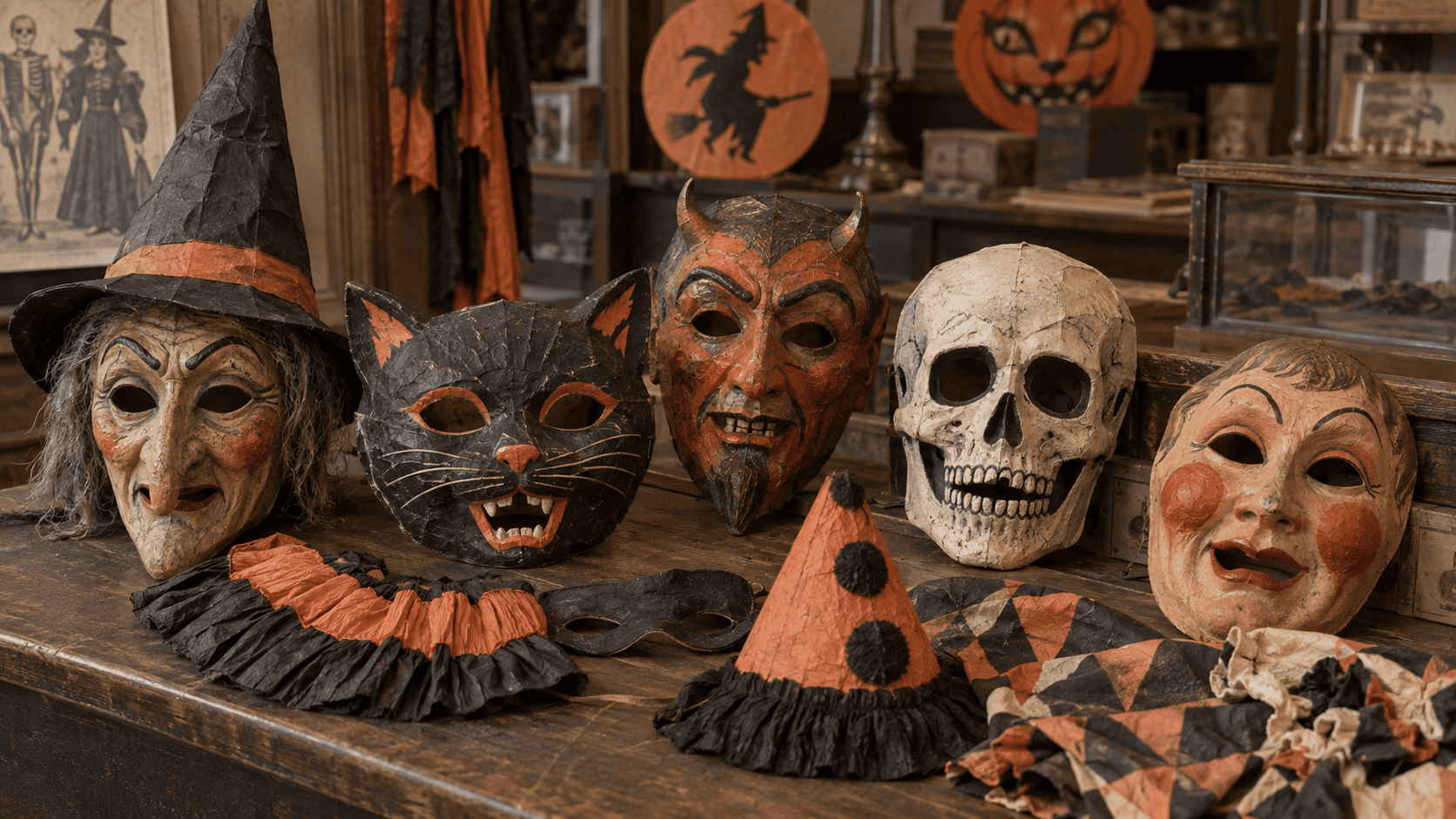
Paper products were particularly important in early commercial Halloween. Manufacturers sold crepe-paper costumes, cardboard decorations, party accessories, and inexpensive masks. Dennison Manufacturing promoted elaborate Halloween party ideas and crepe-paper costumes through publications such as its Bogie Books, helping turn Halloween decorating and dressing up into a consumer activity during the early twentieth century.
Companies specializing in seasonal paper goods also produced Halloween imagery ranging from witches and black cats to skeletons, devils, and grotesque faces. Papier-mâché and pressed-paper masks offered manufacturers a practical way to produce colorful, lightweight faces before molded plastics transformed the industry.
Latex, Boxed Costumes, and Mass Production
The development of latex masks began earlier than is sometimes assumed. Hollywood mask maker Don Post was producing early over-the-head latex masks by the late 1930s, helping establish techniques that would later become fundamental to the monster and horror-mask industry.
Meanwhile, companies such as Halco, Ben Cooper, and Collegeville helped expand inexpensive Halloween costumes for a mass audience. By the mid-twentieth century, children could buy boxed costumes that combined a recognizable face mask with a matching outfit. Television, comic books, movies, and advertising gave manufacturers a growing supply of characters that could be licensed and reproduced.
Mass production made masks more consistent, widely available, and inexpensive. Halloween was becoming a national consumer holiday, and the mask was increasingly something purchased rather than improvised at home.
Plastic, Latex, and the Pop-Culture Mask Boom
By the middle decades of the twentieth century, advances in manufacturing transformed both the appearance of Halloween masks and the characters they represented.
Cheap Plastic Masks and Licensed Characters
Thin vacuum-formed plastic masks became one of the defining images of postwar American Halloween. Lightweight and inexpensive to manufacture, they could be molded into recognizable faces, painted quickly, attached with an elastic band, and sold as part of complete costume sets.
The growth of television and children's entertainment accelerated the licensed-costume business. Instead of dressing only as generic ghosts, witches, devils, or animals, children could become superheroes, cartoon characters, television personalities, and movie figures they already recognized.
From Monsters to Celebrities and Political Masks
Mass-market masks also expanded beyond fictional characters. Celebrity and political masks became popular forms of humor and satire, particularly during the second half of the twentieth century. Presidential faces—including Richard Nixon during the 1970s—demonstrated that a Halloween mask could function not only as a frightening disguise but also as an instantly recognizable cultural joke.
At the same time, latex allowed manufacturers to create fuller heads, deeper facial features, wrinkles, wounds, monsters, and increasingly realistic effects that thin plastic masks could not reproduce. This technical development prepared Halloween masks for their next major influence: modern horror cinema.
How Horror Movies Changed Halloween Masks
Horror had been part of Halloween imagery long before the modern slasher film. Universal monsters such as Frankenstein’s monster, Dracula, and the Wolf Man helped make recognizable screen characters part of American costume culture. But beginning in the late twentieth century, individual masks became horror icons in their own right.
Classic Monsters and the Rise of Horror Masks
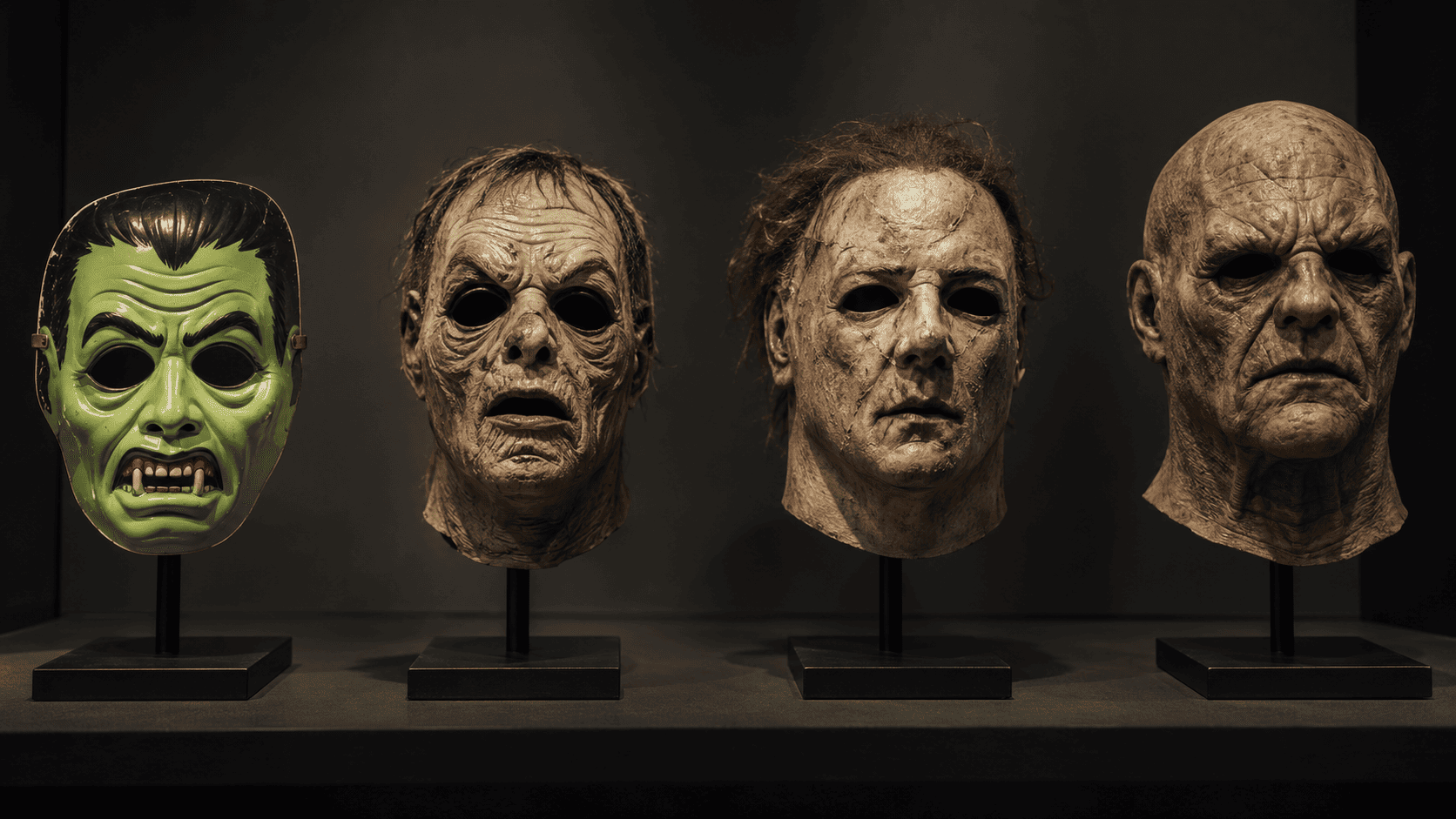
Better latex casting and theatrical makeup techniques allowed commercial masks to imitate creatures seen in movies with greater realism. Monster masks no longer needed to be simple printed faces. They could include textured skin, scars, hair, protruding features, and full-head forms, making them attractive not only to children but also to adult horror fans and collectors.
Slasher Movies and the Modern Iconic Mask
Halloween (1978) gave American horror one of its most recognizable masked figures in Michael Myers. The plain white face became effective precisely because it revealed almost no emotion. Jason Voorhees later adopted his famous hockey mask in Friday the 13th Part III (1982), transforming an ordinary piece of sports equipment into another enduring horror symbol.
In the 1990s, Ghostface from Scream demonstrated how quickly a commercially available mask could become inseparable from a movie character. These examples changed the relationship between Halloween and horror: instead of merely wearing a scary face, people could immediately become a character recognized by millions.
The popularity of such masks also strengthened the collector market. Licensed reproductions, limited editions, screen-inspired replicas, and professional sculpting helped move some Halloween masks beyond disposable costume accessories and into horror memorabilia.
Halloween Masks Today: Realism, DIY, and Technology
Modern Halloween masks range from inexpensive costume accessories to highly detailed works made for collectors, haunted attractions, performers, and dedicated horror fans. The basic purpose of transformation remains familiar, but materials and production methods have expanded dramatically.
Latex and Silicone Masks
Latex remains widely used because it can reproduce detailed sculpted forms at a relatively accessible cost. High-end silicone masks offer another level of realism: flexible material can move more naturally with the wearer’s face, allowing convincing skin textures, wrinkles, creatures, and human likenesses.
Professional mask studios now serve markets far beyond ordinary trick-or-treating, including haunted houses, film productions, collectors, cosplay, and immersive entertainment.
Custom Masks, 3D Printing, and Digital-Age Fandom
Digital sculpting and 3D printing have made it easier for independent artists to prototype original masks and create highly customized forms. Online communities also allow makers to share sculpting, molding, painting, and finishing techniques with audiences around the world.
Some contemporary designs incorporate LEDs, mechanical movement, or other electronic effects, while others intentionally return to handmade paper, fabric, and traditional monster aesthetics. Modern Halloween masking therefore includes both advanced fabrication and deliberate nostalgia.
From seasonal disguises and European guising traditions to paper masks, molded plastic, Hollywood monsters, and realistic silicone creations, Halloween masks have continually adapted to the culture around them. Their appearance has changed dramatically, but their central appeal remains remarkably consistent: for one night, a mask gives the wearer permission to hide an ordinary identity and become someone—or something—else.
Topeng Dance: History, Masks, Meaning, and Traditions
Theater Masks: History, Meaning, and Comedy & Tragedy Symbols
The Fascinating World of Masks: History, Culture, and Significance
History of Venetian Masks: Origins, Carnival, and Tradition
History of Chinese Masks: Origins, Types & Meanings
The Cultural History and Evolution of Dance Masks
Explore More Mask Stories 👇