
Noh Masks: History, Types, Meaning & Expression
Noh masks are carved wooden masks used in Japanese Noh theater to portray specific human and supernatural characters. The tradition includes about 60 primary mask types and more than 200 recognized models when classified in greater detail, representing women, men, old people, spirits, deities, and other beings.
Although their carved features remain physically fixed, a skilled performer can make the same mask appear serene, joyful, sorrowful, or threatening through subtle changes in head angle, movement, and light. Understanding these masks therefore requires looking at both the characters they represent and the performance techniques that bring them to life. For a broader historical overview, explore our guide to the history of masks across different cultures.
What Are Noh Masks?
Noh masks, often referred to as omote in the context of Noh performance, are carefully carved and painted masks used to establish the identity, age, gender, social position, or supernatural nature of particular characters. They are most closely associated with the shite, or main performer, although other performers may also wear them when a role requires it.
The meaning of a mask comes from the character and dramatic context in which it appears rather than from a universal symbolic code. Two masks that look similar to an inexperienced viewer may represent different ages, personalities, or emotional states within the conventions of Noh.
Noh Masks vs. Kyogen Masks
Noh and Kyogen are performed together within the theatrical tradition known as Nohgaku, but masks play different roles in the two forms. Noh relies heavily on masks for female characters, elderly figures, deities, ghosts, spirits, and other supernatural beings. Kyogen, the comic dramatic form traditionally performed alongside Noh, is principally performed without masks, although masks are used for certain special characters such as animals, deities, and supernatural beings.
This distinction is useful because Noh and Kyogen share the same broader theatrical tradition without using masks in exactly the same way. For comparison with other Japanese mask traditions, including Hannya, Kitsune, Oni, Tengu, and festival masks, see our broader guide.
The History of Noh Masks
The history of Noh masks is closely connected with the development of Noh itself. Rather than appearing suddenly as a complete theatrical system, Noh emerged from earlier Japanese performance traditions that gradually combined music, dance, mimicry, religious themes, and dramatic storytelling. For the broader development and use of theater masks across performance traditions, see our dedicated guide.
From Sarugaku to Classical Noh
Among Noh’s important predecessors was sarugaku, a form of popular entertainment with roots in older performing traditions. By the 14th century, performers such as Kan'ami and his son Zeami transformed these earlier forms into a more refined theatrical art. Their company gained the patronage of shogun Ashikaga Yoshimitsu, helping establish Noh within elite cultural life during the Muromachi period.
Zeami was especially important for the development of Noh aesthetics, performance theory, and repertory. Masks became increasingly integrated into a theatrical system in which restrained movement, music, poetry, costume, and character type worked together rather than depending on realistic facial acting.
The Muromachi Period and the Development of Mask Types
Many of the mask categories and names still recognized today developed or became standardized during the medieval and early modern history of Noh. Carvers refined distinctions between young and mature women, old men, warriors, spirits, deities, and other roles, creating a visual vocabulary that performers and audiences could recognize.
Some Okina masks predate the fully developed form of Noh associated with Kan'ami and Zeami, with surviving examples connected to performance traditions of the Kamakura and Nanbokuchō periods. Their history shows that not every mask tradition later incorporated into Noh originated at exactly the same moment.
Surviving historical masks also show that different woods were used in earlier periods. Over time, established models became increasingly important, and later carvers often studied and reproduced respected examples rather than continually inventing entirely new types. This combination of inherited models and subtle individual variation remains central to Noh mask making.
Types of Noh Masks and What They Represent
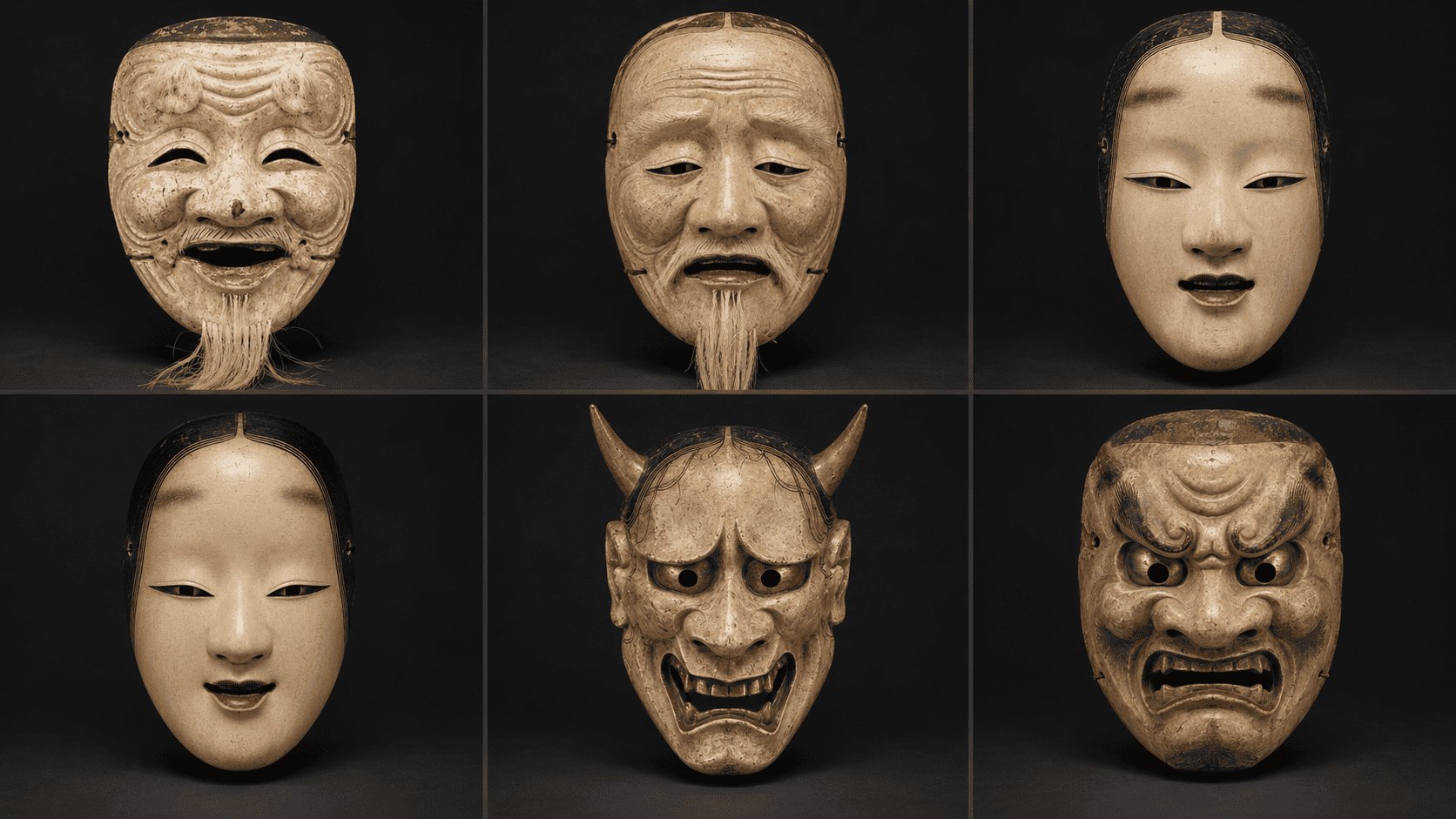
Noh masks are commonly organized according to the kinds of characters they portray. Individual schools and plays may use different names or models, but several broad categories recur throughout the repertory. Age, facial structure, expression, and dramatic identity help distinguish one type from another.
| Category | Represents | Examples |
|---|---|---|
| Okina | Special ritual elderly or deity-like figures | Hakushiki-jō, Kokushiki-jō |
| Old Man | Elderly men, gods, spirits, and venerable figures | Ko-jō, Shiwa-jō |
| Male | Youths, warriors, courtiers, and other male characters | Dōji, Chūjō, Heita |
| Female | Women of different ages, personalities, and dramatic roles | Ko-omote, Waka-onna, Zō-onna, Fukai |
| Spirits | Ghosts, transformed figures, and other supernatural beings | Hannya, Deigan, Yase-otoko |
| Fierce Deities | Powerful gods, demons, and supernatural figures | Tobide, Beshimi, Shikami |
Okina Masks
Okina masks occupy a special position because they are associated with the ceremonial Okina or Shiki-sanban tradition, which has a strongly ritual character. Masks such as Hakushiki-jō represent venerable and auspicious elderly figures rather than ordinary dramatic characters.
Kokushiki-jō occupies a particularly distinctive position within this tradition because it is worn by a Kyogen performer for Sanbasō. It can therefore appear within classifications of the Okina mask group while also reflecting the close historical relationship between Noh and Kyogen within Nohgaku.
Okina masks differ noticeably from many later character masks, with deeply lined features, separate facial-hair elements, and, in some examples, an articulated lower jaw. Their ceremonial use should not simply be grouped with ordinary old-man character masks.
Old Man Masks (Jō-men)
Old-man masks include types such as Ko-jō and Shiwa-jō. Depending on the play, they may portray an elderly human character or a deity who first appears in the form of an old man. Wrinkles, sunken cheeks, white hair, and differences in the eyes or mouth help distinguish one type from another.
An elderly appearance therefore does not by itself determine the character’s identity: the same broad visual category can include human figures as well as supernatural beings appearing in human form.
Male Masks (Otoko-men)
Male masks cover a wide range of ages and identities. Dōji represents a youthful male figure, while Chūjō is associated with refined young or aristocratic men and can appear in roles involving troubled or ghostly warriors. Heita presents a stronger, more mature masculine face suitable for particular warrior roles.
Adult male characters can also be performed with the actor’s uncovered face, so male characterization in Noh does not always depend on a mask.
Female Masks (Onna-men)
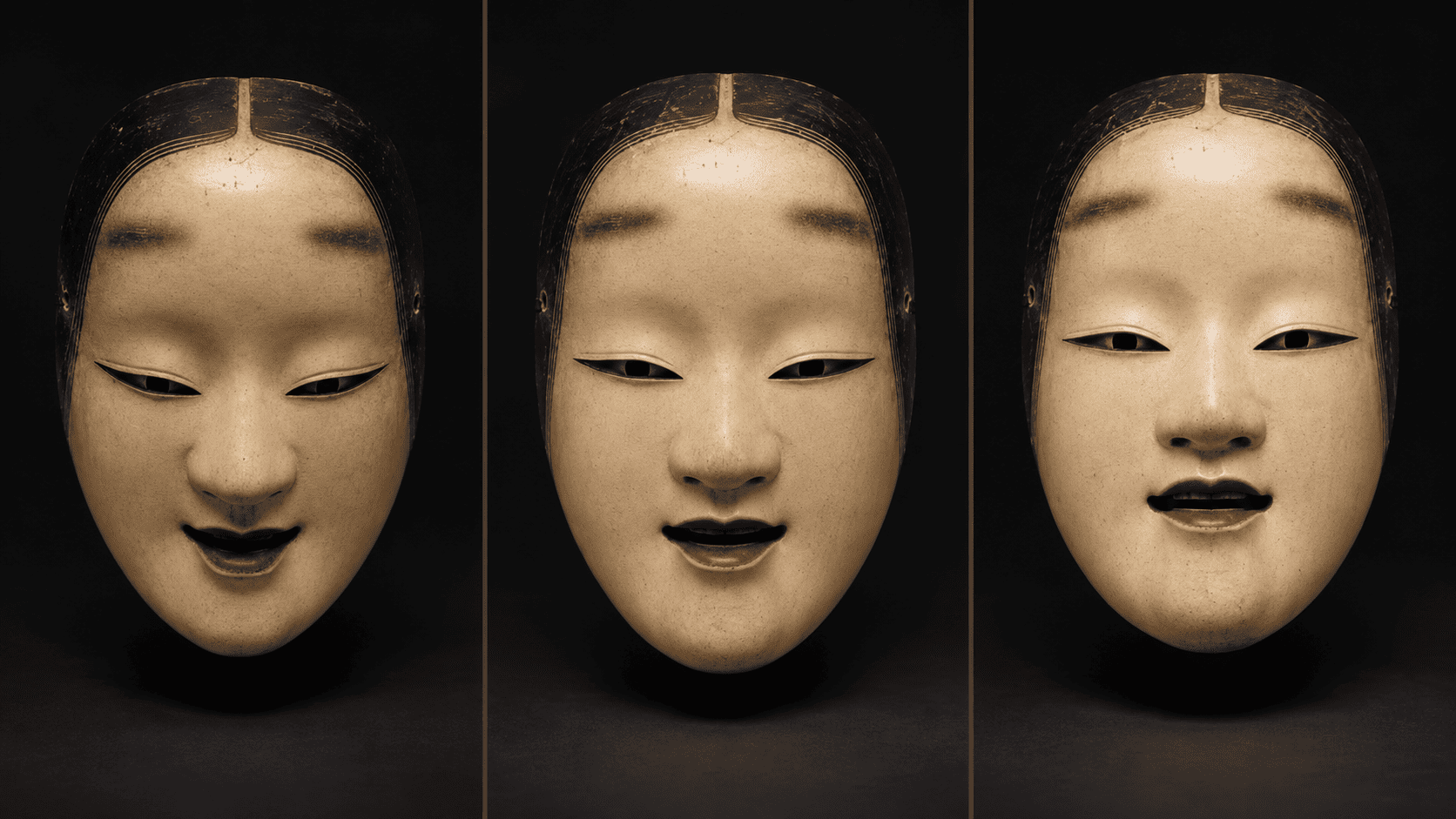
Female masks are among the most subtle and recognizable Noh masks. Ko-omote represents a youthful woman with small, delicate features and an impression of innocence. Waka-onna is another young-woman type used by particular schools, while Zō-onna can suggest a more composed or dignified female presence.
Masks such as Fukai and Shakumi generally represent more mature women rather than simply “old women.” Small changes in the cheeks, eyes, lips, and facial proportions can communicate maturity, experience, grief, or emotional depth. Masks such as Uba and Rōjo are more specifically associated with elderly female figures.
The differences can be so restrained that two masks may initially appear almost identical. Within Noh, however, these variations help establish the character’s age, temperament, and dramatic identity.
Spirit Masks (Onryō-men)
Spirit masks portray ghosts, transformed beings, and characters whose emotional attachments or suffering extend beyond ordinary human life. The category includes several distinct mask types rather than a single “Onryō mask.”
The best-known example is the Hannya mask, which represents a demonic female figure associated with intense jealousy, resentment, rage, and emotional suffering. Its horns, metallic eyes, and open mouth create a frightening appearance, but the character is not simply a symbol of evil. Depending on the performer’s angle and movement, the same face can also convey anguish and vulnerability, giving Hannya a strongly tragic dimension.
Other spirit masks include Deigan, whose distinctive eyes and expression can suggest a woman moving toward supernatural transformation, and Yase-otoko, an emaciated male spirit associated with suffering after death.
Fierce Deity Masks (Kijin-men)
Fierce-deity masks represent powerful supernatural beings and include families of masks such as Tobide, Beshimi, and Shikami. Their bulging eyes, compressed mouths, exaggerated brows, or forceful facial structures distinguish them from the more restrained human masks.
A fierce appearance does not automatically mean that the character is morally evil. Depending on the play, an intimidating supernatural figure may represent divine power, protection, anger, danger, or a force that must be confronted or pacified.
How Masks Express Emotion on Stage
A Noh mask has fixed carved features, but the audience’s perception of its expression can change during a performance. The effect depends on the interaction between the shape of the mask, stage lighting, the performer’s posture, and extremely controlled movements of the head.
Terasu and Kumorasu
Noh performers use subtle techniques often described as terasu and kumorasu. In terasu, the face is oriented slightly upward so that more light reaches the mask, which can create a brighter or more open impression. In kumorasu, the mask is angled downward, increasing shadow and often producing a darker, more sorrowful, or introspective appearance.
The effect is particularly noticeable in female masks such as Ko-omote, whose restrained features allow light and shadow to change how the mouth and eyes are perceived. Hannya can produce an even stronger contrast: one angle may emphasize aggression, while another can bring out pain or despair.
The mask does not mechanically change expression. The apparent transformation is produced by the performer, which is why describing Noh masks as simply “expressionless” overlooks an essential part of their theatrical design.
Who Wears the Masks and How Are They Chosen?
Mask use in Noh follows established theatrical conventions. Different characters and performer roles have different practices, while individual schools preserve their own traditions concerning appropriate masks and interpretations.
The Shite, Tsure, Waki, and Hitamen
The shite, or principal actor, is the performer most closely associated with mask use. Female characters, elderly figures, deities, ghosts, and supernatural beings are commonly masked. A tsure, an accompanying performer connected with the shite, may also wear a mask when the role requires it.
The waki, who often plays a priest, traveler, or other human observer, normally performs without a mask. Adult male shite roles may also be performed unmasked. This use of the actor’s uncovered face is known as hitamen. Even then, the performer avoids ordinary realistic facial acting and maintains the restrained physical discipline associated with Noh.
Choosing the Mask for a Performance
Established conventions narrow the range of masks appropriate for a particular role, but selection is not always completely automatic. Different Noh schools may favor different mask types for the same play, and experienced performers can choose among suitable masks to support a particular interpretation of the character.
Individual historical masks also differ subtly in expression and proportion, so choosing one example rather than another can influence how a role is perceived before the performance even begins.
The Mirror Room and Limited Vision
Before entering the stage, the shite prepares in the kagami-no-ma, or mirror room. The performer faces a large mirror and puts on the mask as part of the transition into the role. The moment also has a practical dimension because the actor must adjust to seeing the stage through very small eye openings.
A Noh mask significantly restricts peripheral vision. The architecture of the Noh stage helps performers maintain orientation: its four pillars provide fixed reference points used together with extensive rehearsal, measured movement, and spatial memory. Mask technique is therefore closely connected with the physical discipline of Noh acting.
Materials and Traditional Mask Making
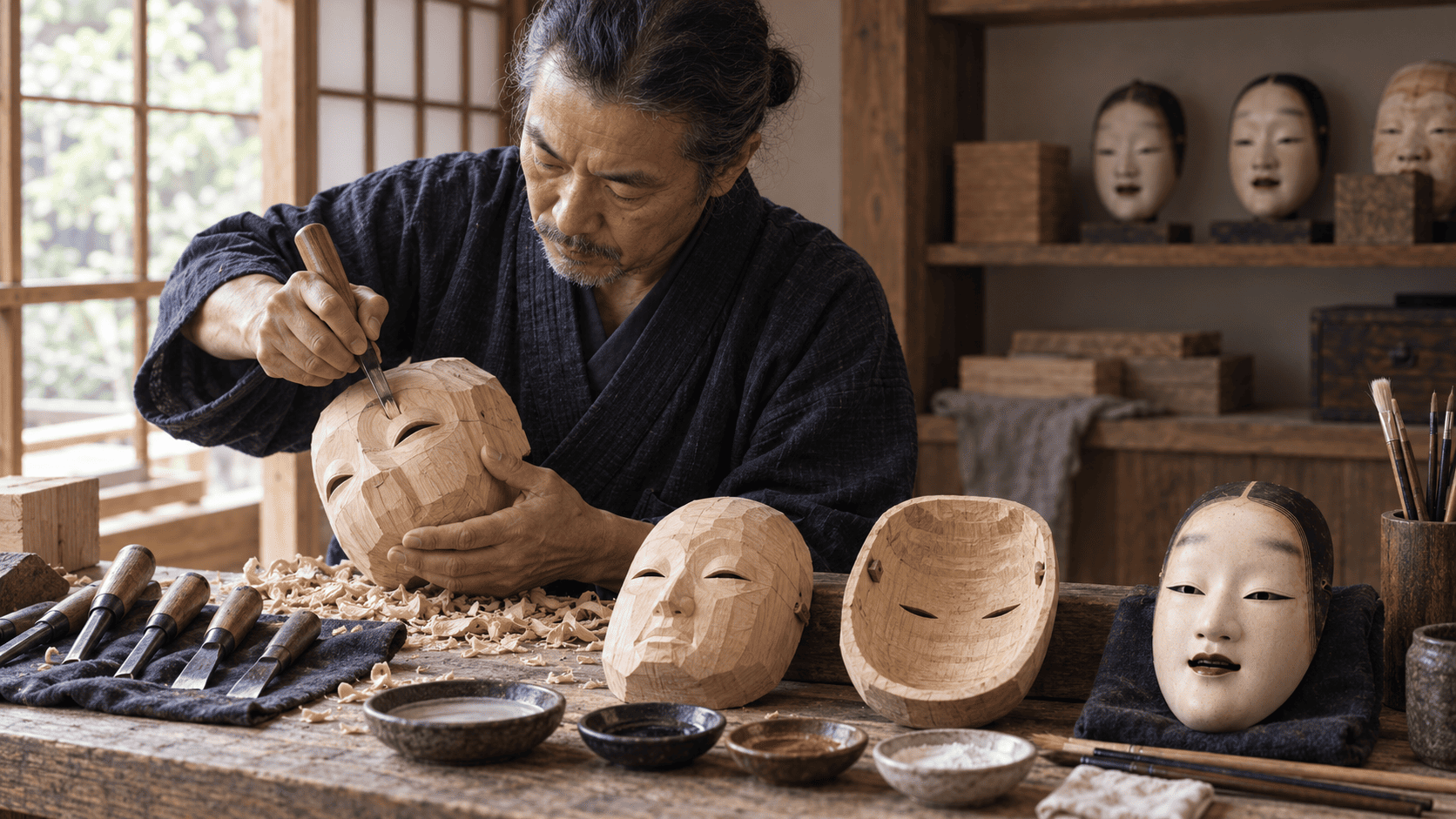
Noh mask making combines sculpture, painting, knowledge of established models, and an understanding of theatrical requirements. Modern carvers commonly use Japanese cypress, while surviving historical masks show that several types of wood were used in earlier periods.
Hinoki Cypress, Gofun, and Pigments
A mask begins as a block of wood that is gradually carved into the required facial form. Hinoki cypress is widely favored by modern Noh mask makers because it is relatively light, fine-grained, and suitable for detailed carving. The reverse side is hollowed so that the finished mask can fit over the performer’s face, while small openings are cut for the eyes and nostrils.
The carved surface is prepared and painted in layers. Traditional finishes may use gofun, a white pigment made primarily from finely processed oyster shell, together with binding material and additional pigments. Hair, eyebrows, lips, teeth, wrinkles, and other details are then carefully added according to the mask type.
The objective is not photographic realism. A successful mask must preserve the established character type while giving the performer a finely balanced face suitable for the restrained visual language of Noh.
A Living Theatrical Tradition
Noh masks are not simply historical museum objects. Nohgaku remains a living theatrical tradition, and masks continue to be used in performances, preserved within Noh families and institutions, studied in museums, and carved by contemporary mask makers. Historic examples can serve as models for later generations, allowing recognizable mask types to continue while individual carvers introduce subtle differences in workmanship.
UNESCO recognizes Nohgaku theater as Intangible Cultural Heritage, reflecting the continuing importance of the complete performance tradition rather than the masks alone. Within that tradition, the mask remains connected with the actor, costume, music, text, stage, and movement. Its significance ultimately comes from how a carefully carved face functions within a specific character and performance.
Topeng Dance: History, Masks, Meaning, and Traditions
History of Halloween Masks: Origins to Modern Horror
Theater Masks: History, Meaning, and Comedy & Tragedy Symbols
History of Chinese Masks: Origins, Types & Meanings
The Cultural History and Evolution of Dance Masks
The Fascinating World of Masks: History, Culture, and Significance
Explore More Mask Stories 👇