
Theater Masks: History, Meaning, and Comedy & Tragedy Symbols
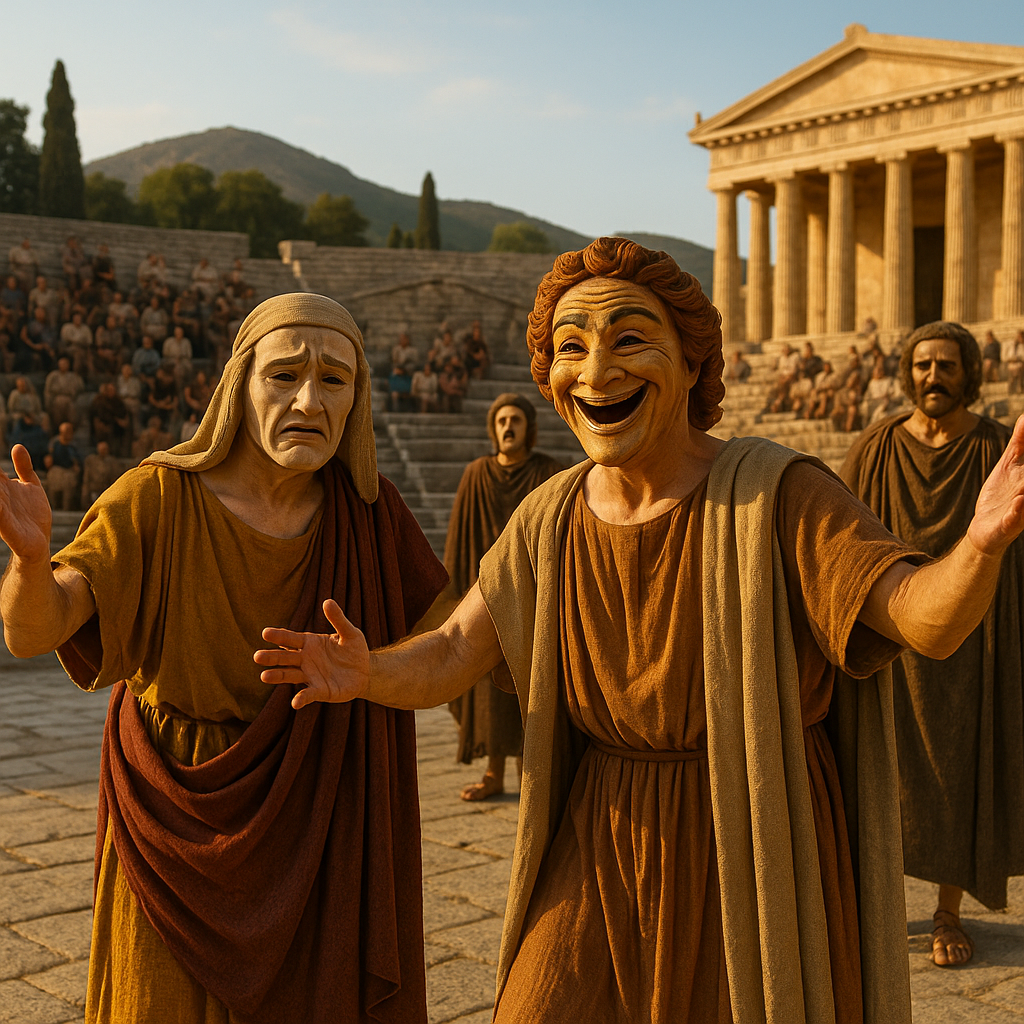
Theater masks are performance tools that transform an actor’s face into a character, but today the term is most closely associated with the familiar comedy and tragedy symbols. The smiling mask represents comedy, while the frowning mask represents tragedy; the pair is commonly linked with the Muses Thalia and Melpomene.
Ancient Greek actors, however, used many different character masks rather than only two. Their masks helped distinguish roles, support visual storytelling in large theaters, and connect performance with festivals honoring Dionysus. Over time, masked theater developed in Roman drama, commedia dell’arte, Japanese Noh, and modern actor training. For a broader view of masking across cultures, see our guide to the history of masks.
What Do Theater Masks Mean?
The two most recognizable theater masks symbolize comedy and tragedy, the contrasting dramatic modes that became central to Western theater. Together, they represent the range of emotions explored onstage, from laughter and celebration to suffering and loss. Their modern meaning is symbolic: they stand for theater as an art form, not for the only two masks used by ancient performers.
The Comedy Mask
The smiling or laughing mask represents comedy. In modern theater symbolism, it is associated with humor, satire, celebration, and comic storytelling. Ancient Greek comedy used many different character types, so the familiar smiling face should be understood as a later emblem of the genre rather than a reconstruction of one standard historical comedy mask.
The Tragedy Mask
The frowning or sorrowful mask represents tragedy. It is associated with grief, conflict, suffering, serious drama, and the consequences of human choices. As with the comedy mask, the modern sad face summarizes a dramatic genre that originally used a much wider range of character masks.
Thalia and Melpomene
The comedy and tragedy symbols are often associated with Thalia and Melpomene. In Greek mythology, Thalia is the Muse of comedy and idyllic poetry, while Melpomene became the Muse of tragedy. Their names are now commonly used when explaining the two theater faces, but they were not simply the historical names of two masks worn by Greek actors.
| Modern Theater Symbol | Meaning | Traditional Association |
|---|---|---|
| Smiling mask | Comedy, humor, laughter | Thalia |
| Frowning mask | Tragedy, grief, serious drama | Melpomene |
The pair is also commonly called the drama masks, the happy and sad masks, or simply the theater masks. These modern labels all refer to the same symbolic contrast between comedy and tragedy, although the historical tradition behind theatrical masking is much broader than the two-face emblem.
Why Did Ancient Greek Actors Wear Masks?
Ancient Greek theater masks helped performers become recognizable characters and gave audiences visual information about age, gender, personality, social type, and dramatic role. Because Greek theaters could hold large audiences, bold facial forms also made character differences easier to read from a distance.
Character Identity and Multiple Roles
Greek dramatic casts were limited, and the same actor could perform more than one role. Changing a mask, costume, and posture allowed a performer to become another character quickly. Masks were therefore not merely decorative objects; they were part of a practical stage system for distinguishing roles and helping the audience follow the action.
Visibility, Gesture, and Large Audiences
Ancient Greek theaters were open-air spaces designed for large crowds. A mask could present a clear visual type even when subtle facial expressions would have been difficult to see from distant seats. This did not mean that the mask alone communicated emotion. Costume, body position, gesture, movement, voice, chorus, and the conventions of the dramatic genre all worked together.
Theater, Ritual, and Dionysian Festivals
Greek drama developed in close association with festivals honoring Dionysus, especially in Athens. Tragedy and comedy became formal competitive genres within this religious and civic setting. Major festivals brought together playwrights, actors, choruses, judges, and large civic audiences. Masks therefore belonged not only to theatrical technique but also to a culture in which performance, public identity, ritual, music, and communal storytelling overlapped.
Did Greek Theater Masks Amplify the Actor’s Voice?
The claim that Greek masks worked like simple megaphones is too strong. Because no original stage masks survive, researchers must study reconstructions. Experimental work suggests that the shape of a reconstructed mask can alter how the voice radiates and may strengthen some frequencies, but the effect depends on the mask, performer, and acoustic environment. It is safer to say that masks may have influenced vocal projection rather than to describe them as built-in amplifiers.
The Origins of Theater Masks in Ancient Greece
The precise beginnings of Greek drama are not fully documented, but tragedy and comedy developed during the Archaic and Classical periods and became closely connected with Athenian festivals of Dionysus. By the fifth century BCE, masked performance was a defining convention of Greek tragedy and comedy. Satyr drama, another competitive form associated with tragic playwrights, also used masks and helped demonstrate how varied Greek theatrical faces could be.
Tragedy, Comedy, and Dionysian Festivals
Tragedy, comedy, and satyr drama developed as distinct forms with different conventions and character types. The modern pairing of a smiling and a sorrowful face reflects the later symbolic opposition between comedy and tragedy, but ancient actors did not simply switch between one “comedy mask” and one “tragedy mask.” Each genre used many masks suited to different roles.
What Ancient Greek Theater Masks Looked Like
We know the appearance of theatrical masks indirectly. Greek vase paintings show masked performers and scenes connected with drama, while terracotta figurines, reliefs, sculptures, and later written descriptions preserve characteristic faces and theatrical types. Some surviving terracotta objects resemble masks but are too small, heavy, or fragile to have been worn in performance.
Materials and Construction
Greek stage masks were probably made from lightweight, perishable materials such as linen, leather, wood, or combinations of organic materials. They could be painted and shaped to make the character legible to an audience. A performance mask also worked together with hair, costume, and head covering to create the character’s complete visual identity. Because organic materials decay, surviving stone and terracotta representations should not automatically be treated as the actual masks used onstage.
Why No Original Greek Stage Masks Survive
No securely identified ancient Greek stage mask made for regular dramatic performance has survived intact. This is one reason historians must be cautious when describing exact dimensions, colors, materials, or acoustic properties. Many surviving terracotta “theater masks” were models, votive objects, decorative pieces, or representations of theatrical types rather than wearable stage equipment. The surviving evidence is indirect, but when images, artifacts, architecture, and written sources are considered together, they give a detailed picture of how important masking was to Greek performance.
Were There Only Two Greek Theater Masks?
No. The familiar happy and sad theater masks are modern symbols for comedy and tragedy, not a complete inventory of ancient Greek masks. Greek performers used numerous character masks that could distinguish men and women, young and old characters, slaves, citizens, gods, heroes, comic stereotypes, and other dramatic roles.
Character Masks in Tragedy and Comedy
Different dramatic genres developed recognizable visual conventions. Tragic masks could identify heroic, royal, divine, youthful, elderly, or suffering characters, while comedy often employed more exaggerated or grotesque faces. Later evidence shows increasingly detailed classifications of stock characters. The second-century CE writer Julius Pollux, for example, cataloged dozens of tragic and comic mask types, including extensive classifications for tragedy and New Comedy. His account is valuable evidence for later theatrical conventions, but it was written centuries after the great fifth-century BCE tragedies and should not be projected backward without caution.
How We Know What Ancient Masks Looked Like
Because the original stage masks disappeared, visual evidence matters greatly. Vase paintings can show actors holding or wearing masks; terracotta figurines preserve comic and tragic facial types; reliefs and decorative objects show theatrical iconography; and written sources describe roles and conventions. Each source has limits, so historians compare several kinds of evidence rather than relying on a single surviving object.
| Historical Evidence | What It Can Tell Us |
|---|---|
| Vase paintings | Actors, costumes, masks, and performance scenes |
| Terracotta figurines and mask models | Character types and theatrical facial conventions |
| Reliefs and sculpture | Theatrical imagery and recognizable mask forms |
| Written descriptions | Roles, genres, terminology, and later mask classifications |
What Are the Comedy and Tragedy Masks Called?
The two modern theater faces are usually called the comedy and tragedy masks or the comedy and drama masks. They are often associated with Thalia and Melpomene because those Muses represent comedy and tragedy. Calling the masks themselves “Thalia and Melpomene” is common in modern explanations, but historically the names belong to the Muses rather than to two standard pieces of acting equipment.
What “Sock and Buskin” Actually Means
Sock and buskin is another traditional expression for comedy and tragedy, but it originally refers to footwear rather than masks. The low soccus became associated with comedy, while the higher cothurnus, or buskin, was associated with tragedy. Over time, “sock and buskin” became a symbolic way of referring to the dramatic arts themselves.
How Theater Masks Evolved After Ancient Greece
Masks in Roman Theater
Roman theater inherited and adapted many Greek dramatic traditions. Masks continued to appear in theatrical imagery and were associated with recognizable roles in comedy, tragedy, and other forms of performance, although their use varied by genre and period. Roman visual art frequently depicts theatrical masks as recognizable cultural objects, and mosaics, paintings, sculptures, and terracotta figures preserve many comic and tragic faces. These images helped carry the visual language of classical theater well beyond the period in which the plays themselves were first performed.
Commedia dell’Arte
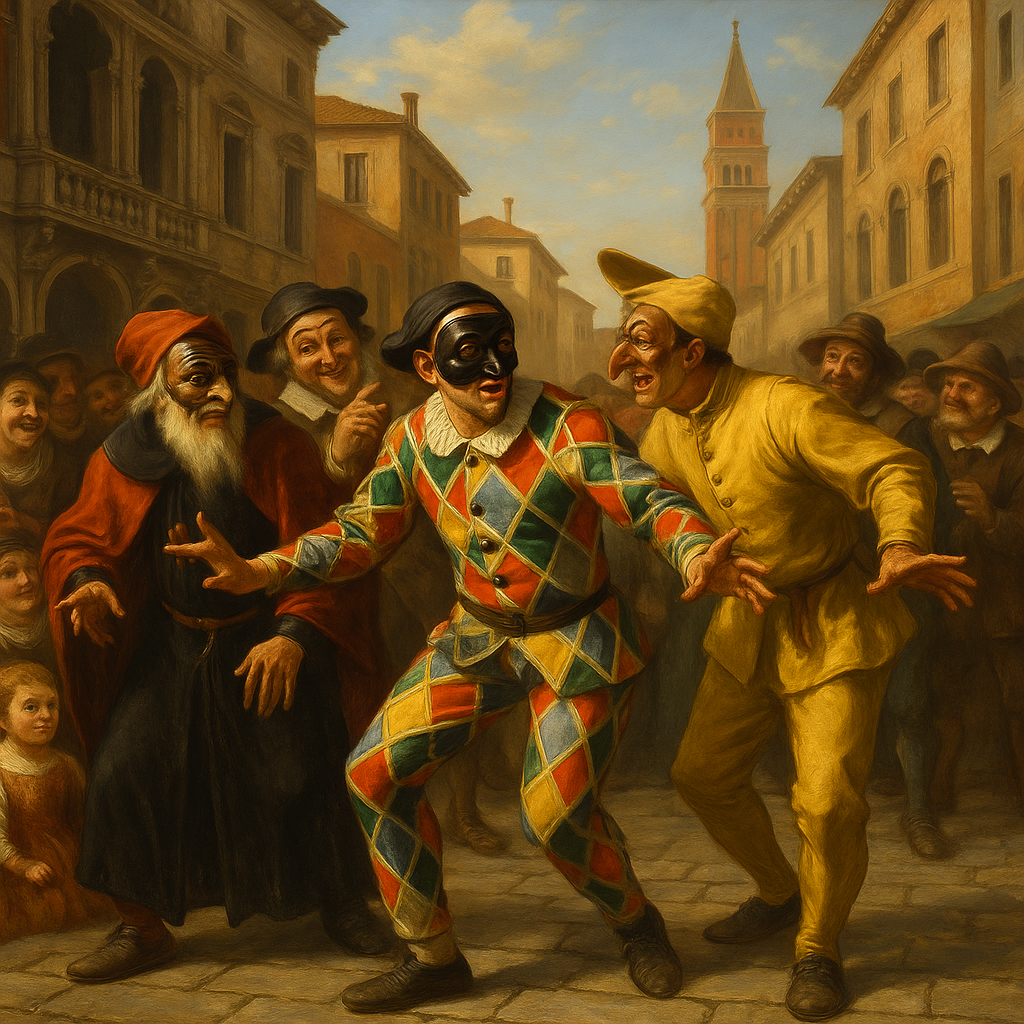
In Renaissance Italy, commedia dell’arte developed a different but highly influential mask tradition. Beginning in the sixteenth century, professional performers used recognizable stock characters such as Pantalone, Il Dottore, and various zanni. Many wore half masks that left the mouth free, supporting rapid speech, improvisation, and exaggerated physical comedy. The mask did not simply hide the actor: its fixed nose, brows, cheeks, and profile established an archetype that the performer completed through gesture, voice, posture, and repeated comic behavior.
Noh and Other Masked Theater Traditions
Masked theater also developed independently outside Europe. In Japan, Noh theater became highly formalized from the fourteenth century onward. Its carved Noh masks can represent women, old men, deities, ghosts, demons, and other roles. Many Noh masks use restrained features rather than a single exaggerated emotion. By subtly tilting the mask and changing posture, the performer can alter how light falls across the eyes and mouth, making the same carved face appear brighter, darker, calmer, or more sorrowful.
These traditions should not be treated as one continuous historical line. Greek theater, commedia dell’arte, Noh, Indonesian Topeng, and other masked performance forms developed in different cultural settings, but all demonstrate how a fixed face can support character transformation through movement, costume, voice, and convention.
Theater Masks in Modern Performance
Character Masks and Actor Training
Masks remain useful in contemporary theater and actor training. When performers cannot rely on subtle facial expressions, they must communicate more clearly through posture, rhythm, gesture, focus, and movement. Mask work can therefore help actors become more aware of how the whole body creates character. Neutral-mask and character-mask exercises are often used to reduce habitual facial acting and make performers more conscious of balance, spatial awareness, physical intention, and the clarity of each movement.
Modern productions also use full masks, half masks, neutral masks, character masks, puppetry, prosthetics, and hybrid visual techniques. Their purpose varies: some create a recognizable role, some emphasize physical theater, and others deliberately distance the performer from everyday realism.
Full-Face, Half, Neutral, and Character Masks
Modern theater uses several broad mask forms rather than one standard design. Full-face masks conceal most or all of the actor’s facial expression and place greater emphasis on the body. Half masks, familiar from commedia dell’arte and many physical-theater traditions, leave the mouth exposed so speech and lower-face movement remain visible. Neutral masks are designed to minimize individual character and are commonly used in training, while character masks exaggerate particular features to suggest age, personality, status, or temperament. These categories can overlap: a character mask may be full-face or half-face depending on the performance tradition.
Why Comedy and Tragedy Masks Still Symbolize Theater
The smiling and frowning faces remain widely used by theaters, drama schools, acting organizations, awards, posters, and visual media because they reduce a complex history to an instantly recognizable symbol. They represent the two dramatic poles of comedy and tragedy, but their real historical background is richer: ancient Greek actors used many masks, later theatrical cultures developed their own systems, and modern mask performance continues to evolve beyond the familiar pair.
Topeng Dance: History, Masks, Meaning, and Traditions
History of Halloween Masks: Origins to Modern Horror
The Fascinating World of Masks: History, Culture, and Significance
History of Venetian Masks: Origins, Carnival, and Tradition
History of Chinese Masks: Origins, Types & Meanings

The Cultural History and Evolution of Dance Masks
Explore More Mask Stories 👇