
Scold’s Bridle: History, Use & How the Punishment Worked
The scold’s bridle, also known as the branks, was a head restraint used to silence and publicly punish people accused of disruptive or unacceptable speech, especially women. An iron framework enclosed the head while a gag or plate entered the mouth and restricted the tongue.
Although the device is often described today as a medieval torture mask, its best-documented use in Britain belongs mainly to the early modern period, beginning in the 16th century. Its history reveals how enforced silence, physical restraint, and public exposure could be combined within local systems of punishment. For other unusual and historically significant examples, explore our guide to famous masks from history and culture.
What Was a Scold’s Bridle?
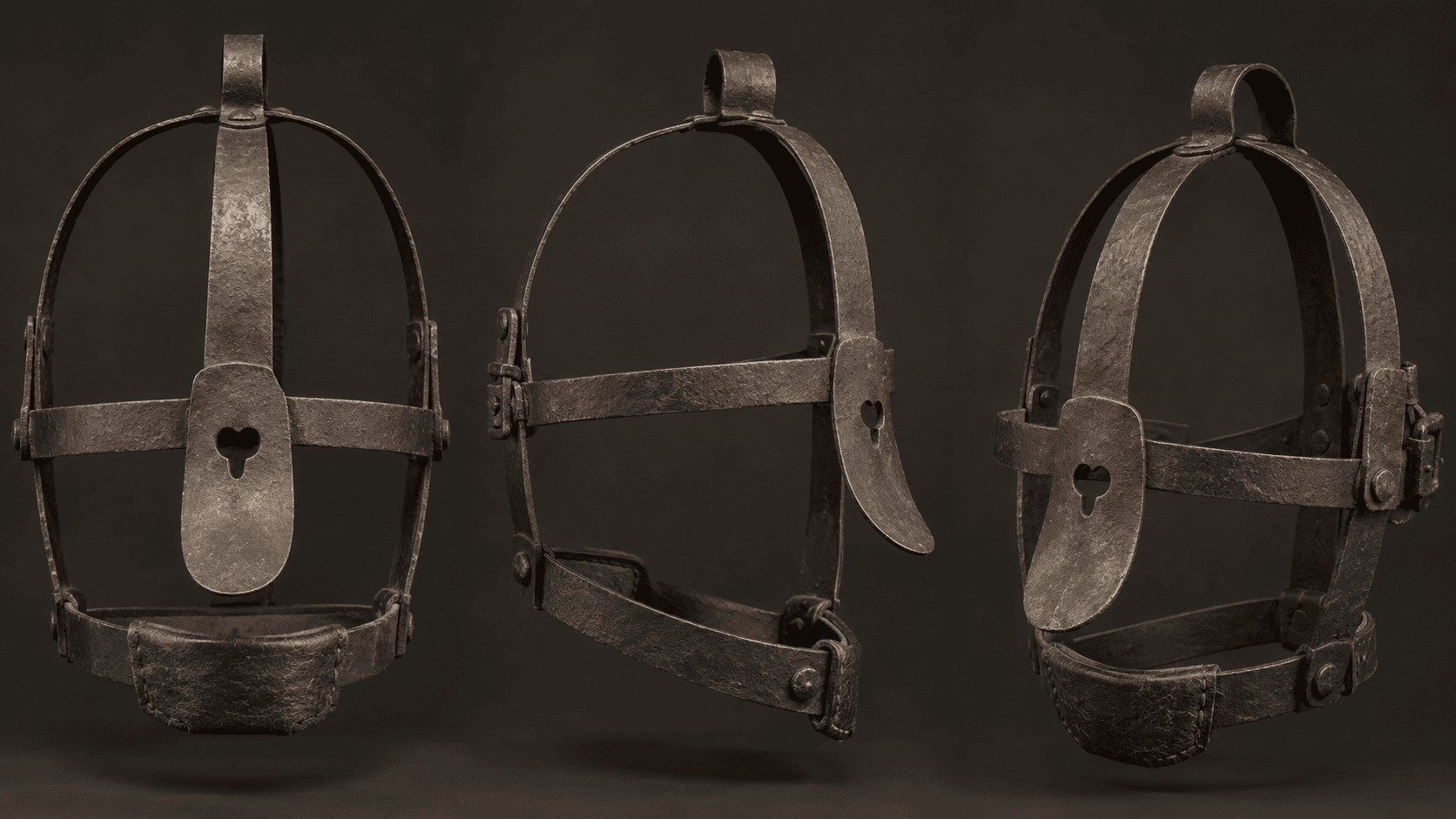
A scold’s bridle was a restraint fitted around the head and designed to prevent or severely restrict speech. Many examples consisted of an iron framework that enclosed the head and fastened at the back. A gag, bit, or metal plate projected into the mouth and pressed against the tongue. Some surviving bridles had spikes, while others used comparatively simple wooden or metal mouthpieces.
Despite modern descriptions such as “punishment mask,” a scold’s bridle did not always resemble a conventional face mask. Some examples are cage-like structures that leave much of the face visible, while others include larger nose pieces, decorative elements, or plates that partly cover the face.
Why Was It Called the Branks or Gossip’s Bridle?
Branks or brank became common names for the device, particularly in Scotland and northern Britain. “Gossip’s bridle” also appears in historical descriptions. The word bridle deliberately evokes equipment used to control a horse: the human wearer was restrained through a bit or gag placed in the mouth.
The word scold had a more specific historical meaning than the modern idea of someone who simply complains. It could describe a person—most commonly a woman—judged to create a public nuisance through quarrelling, slander, abusive speech, or repeated verbal conflict.
Origins and Early Use
The precise origin of the bridle is uncertain, but surviving records show that it became established in Britain during the 16th and 17th centuries. Its documented history is especially associated with Scotland before examples also appear in English records and in other parts of northern Europe.
Was the Scold’s Bridle Really Medieval?
The scold’s bridle is frequently grouped with “medieval torture devices,” but that description can be misleading. The strongest documentary evidence for its use in Britain comes from the early modern period. One of the earliest frequently cited Scottish records dates to 1567, and many surviving museum examples date from the 17th century or later.
Possible earlier European precedents are harder to establish, so it is more accurate to distinguish the device’s popular medieval reputation from its securely documented history. Calling every scold’s bridle a medieval punishment mask obscures the period in which it is most clearly recorded.
Silencing, Humiliation, and Social Control
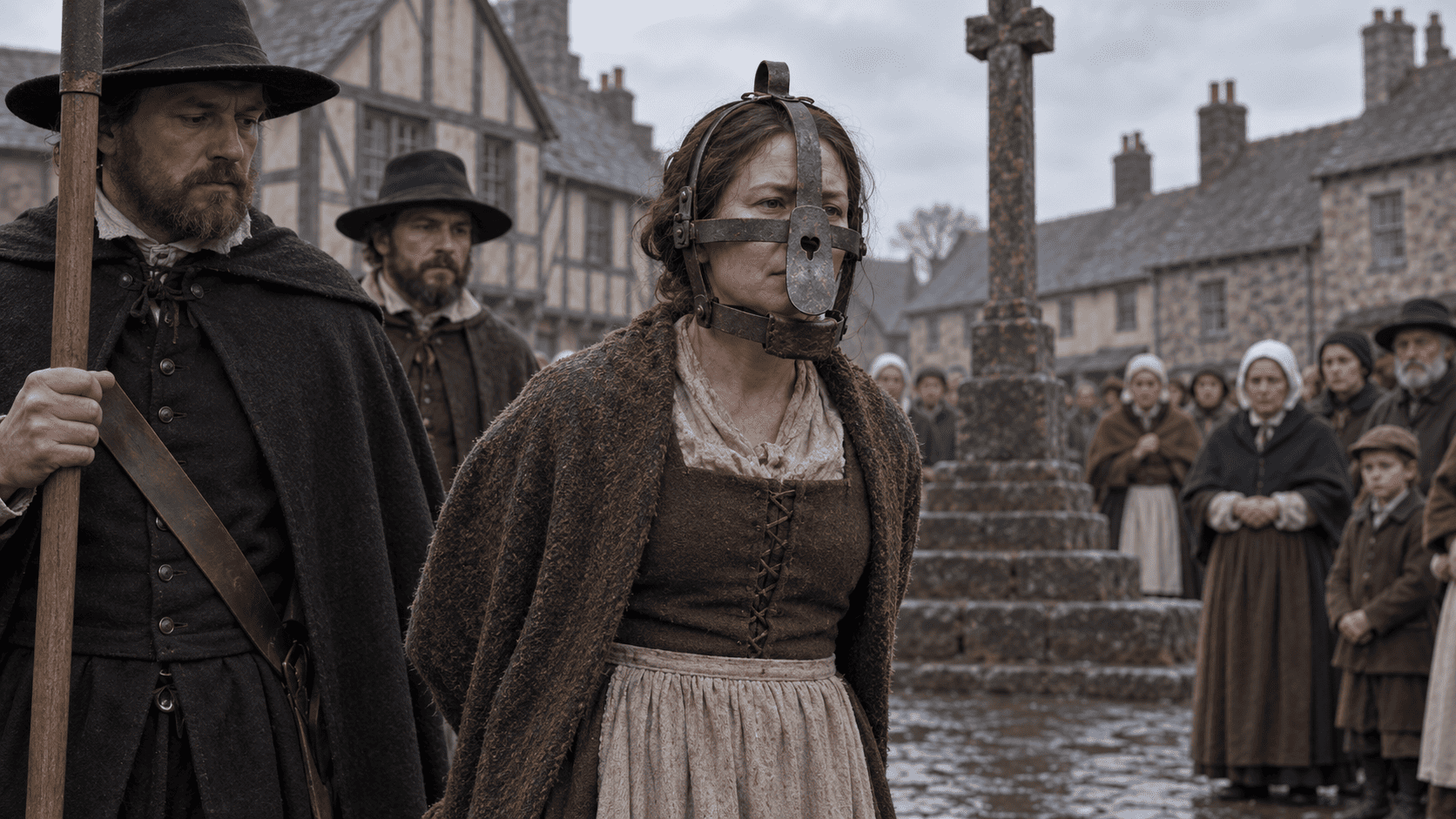
The punishment operated through both restraint and visibility. The mouthpiece prevented the wearer from speaking freely, while public exposure marked the person as an offender before the surrounding community. A wearer could be displayed at a public cross or other prominent place, or in some cases led through the streets.
Because the device became strongly associated with women accused of unacceptable speech, it also reflects early modern expectations about gender and public behavior. Its use was not simply about physical discomfort: authorities could employ the bridle to discipline speech considered quarrelsome, defamatory, disruptive, or defiant.
How the Bridle Worked
There was no single standardized design. Surviving bridles differ considerably in shape, materials, decoration, and severity, but they share the basic principle of securing the head while restricting the mouth and tongue.
Iron Frame, Gag, and Tongue Plate
A typical bridle used hinged iron bands or a cage-like framework that closed around the wearer’s head and could be secured at the back. The internal component might be a wooden bit, an iron gag, or a flat plate positioned over the tongue. Some examples incorporated spikes intended to increase pain if the wearer attempted to speak or move the tongue.
Other surviving bridles were constructed differently. Museum collections include examples made from combinations of iron, wood, leather padding, and different forms of mouthpiece. Some continental examples were given exaggerated noses, horns, jagged mouths, or bells, adding a deliberately degrading visual element to the restraint.
Public Display and Parade
The bridle was often intended to be seen. Historical accounts describe offenders being fixed at public crosses or exposed before the community, while other descriptions refer to wearers being led through streets. This transformed the restraint from a purely physical device into a public punishment in which reputation and social standing were also at stake.
Was the Scold’s Bridle a Torture Device?
Modern sources frequently call the scold’s bridle a torture device, and some surviving designs were clearly capable of causing considerable pain or injury. Historically, however, it is more precise to describe it as a punishment and restraint used to silence and discipline the wearer. Not every surviving example had spikes or the same capacity to cause injury.
The distinction matters because the term “torture device” can suggest one standardized instrument designed primarily to inflict pain. The historical evidence instead shows a family of related restraints that varied in construction and were used in different local punitive contexts.
Surviving Bridles in Museums Today
Surviving museum objects provide important physical evidence for that variation. Seventeenth-century examples preserved by the London Museum include iron frameworks combined with wooden gags and leather padding, while other European specimens feature bells, horns, exaggerated noses, or unusual mouthpieces.
These objects demonstrate that the scold’s bridle was not a single fixed design reproduced identically across Europe. Construction varied according to place, maker, period, and intended use.

Who Was Punished and Why?
The scold’s bridle is overwhelmingly associated with the policing of women’s speech, but the historical picture is more complicated than the familiar image of a device used simply against “nagging wives.” Accusations and enforcement practices varied according to community, authority, and period.
Women Labeled as Common Scolds
Women described as scolds could be accused of quarrelling, slander, abusive language, disturbing the peace, or challenging neighbors and local authorities. The category reflected a wider early modern concern with disruptive public behavior, but it was also strongly gendered. Speech judged unacceptable in women could attract punishments closely connected with obedience and public discipline.
It is therefore misleading to reduce the historical term to “gossiping woman.” Gossip appears in later descriptions of the punishment, but surviving cases also involve disputes, accusations, religious preaching, and other forms of speech considered disorderly or threatening to authority.
Witchcraft, Religious Dissent, and Other Offenses
Bridles also appear in records and later accounts connected with accusations of witchcraft and religious dissent. These contexts should not be treated as the device’s universal purpose. It was not invented solely for accused witches, nor was every person subjected to a bridle suspected of witchcraft.
Religious dissent provides another documented context. Quaker women who preached publicly could face punishment when their speech challenged civic or religious authority, showing that the use of the bridle extended beyond ordinary neighborhood quarrels.
Were Men Ever Forced to Wear One?
The device was predominantly associated with women, but the surviving historical record does not support saying that only women were ever subjected to bridling or related gags. Museum documentation and historical references include evidence of use against men in other punitive contexts, including offenses such as blasphemy or as a form of restraint.
Such cases are much less central to the history of the scold’s bridle than its use against women, so they are better understood as exceptions rather than evidence that the punishment was gender-neutral.
Was the Punishment Legal?
There was no uniform legal framework governing the scold’s bridle across Scotland and England. During much of the period in which bridles are documented, the two kingdoms maintained separate legal and institutional systems, and local enforcement differed considerably.
In Scotland, surviving records show bridling imposed or threatened by local civic, judicial, or church authorities. In England, documentation is scarcer, and its use could be local or extralegal, while other punishments—particularly the cucking or ducking stool—were more firmly associated with the offense of being a common scold.
It is therefore more accurate to describe the bridle as a punishment employed within particular local communities and institutions than as a standardized national sentence.
Documented Cases and Historical Examples
Written cases are especially valuable because they reveal why particular people were punished and how the device functioned within local systems of discipline rather than relying only on later stories about its use.
Scotland: Bessie Tailiefeir, 1567
One of the earliest frequently cited British cases comes from the Canongate in Edinburgh in 1567. Bessie Tailiefeir was accused of slandering Baillie Thomas Hunter by claiming that he kept a false measure in his house. After the accusation was found to be untrue, she was sentenced to be “brankit” and placed at the public cross for an hour.
The case is important because it connects the device directly with punishment for speech and public exposure rather than depending on later folklore about how bridles supposedly functioned.
England: Dorothy Waugh, 1655
Dorothy Waugh, a young Quaker preacher, was subjected to the bridle at Carlisle in 1655 after preaching publicly. Her case is particularly valuable because she later left an account describing her imprisonment and punishment.
Waugh’s experience demonstrates that bridling in England was not confined to accusations of gossip or domestic quarrelling. It could also be used to suppress religious speech by women whose public preaching challenged established authority.
Use Beyond Britain and Later Decline
Related bridles are preserved from Germany, Belgium, and other parts of northern Europe, sometimes with more elaborate or grotesque designs than British examples. The surviving objects show that the broader concept of bridling and gagging as punishment appeared in different regional forms.
The practice gradually declined as systems of punishment changed, although related gags and restraining devices continued to appear in some institutional settings into the early 19th century. Claims about similar iron mouth restraints in colonial or slavery contexts require particular care: related devices existed, but they should not automatically be classified as the same historical object as the British scold’s bridle.
Japanese Mask Meanings: History, Symbolism, and Traditional Types

Hannya Mask Meaning: Symbolism, Colors, and Cultural Legacy

Traditional Indian Masks: Meanings, Rituals & Traditions

The History and Symbolism of Masks in Ancient Greek Theatre

Death Masks: History, Purpose, and Famous Examples

Kitsune Mask Meaning, History, and Symbolism in Japan
Explore More Mask Stories 👇