Death Masks: History, Purpose, and Famous Examples
A death mask is a cast or impression made from a person’s face after death to preserve their physical likeness. For centuries, these casts were used for remembrance, portraiture, funeral monuments, artistic reference, and sometimes identification. They are closely related to life masks and funerary masks, but the three are not the same.
Understanding that distinction helps explain how death masks developed from older traditions of representing the dead into the plaster, wax, and bronze casts associated with historical figures such as Beethoven and Napoleon. For other historically significant examples, explore our guide to famous masks from history and culture.
What Is a Death Mask?
In the strict historical sense, a death mask reproduces the facial features of a deceased person from a mold taken soon after death. The resulting cast preserves details such as the shape of the nose, mouth, forehead, and other features with a degree of accuracy that painted portraits could not always provide.
Death masks were especially valuable before photography became widespread. Families could retain a physical record of a loved one’s face, while sculptors used casts as references for busts, statues, tomb monuments, and funeral effigies.
Death Mask vs. Life Mask vs. Funerary Mask
These terms are often used interchangeably in popular writing, but they describe different objects.
| Type | When It Was Made | Typical Purpose | Example |
|---|---|---|---|
| Death mask | After death | Preserve the face, assist portraiture, memorialize the deceased | Ludwig van Beethoven |
| Life mask | While the person was alive | Create an accurate facial reference for portraits or sculpture | Beethoven’s 1812 life mask |
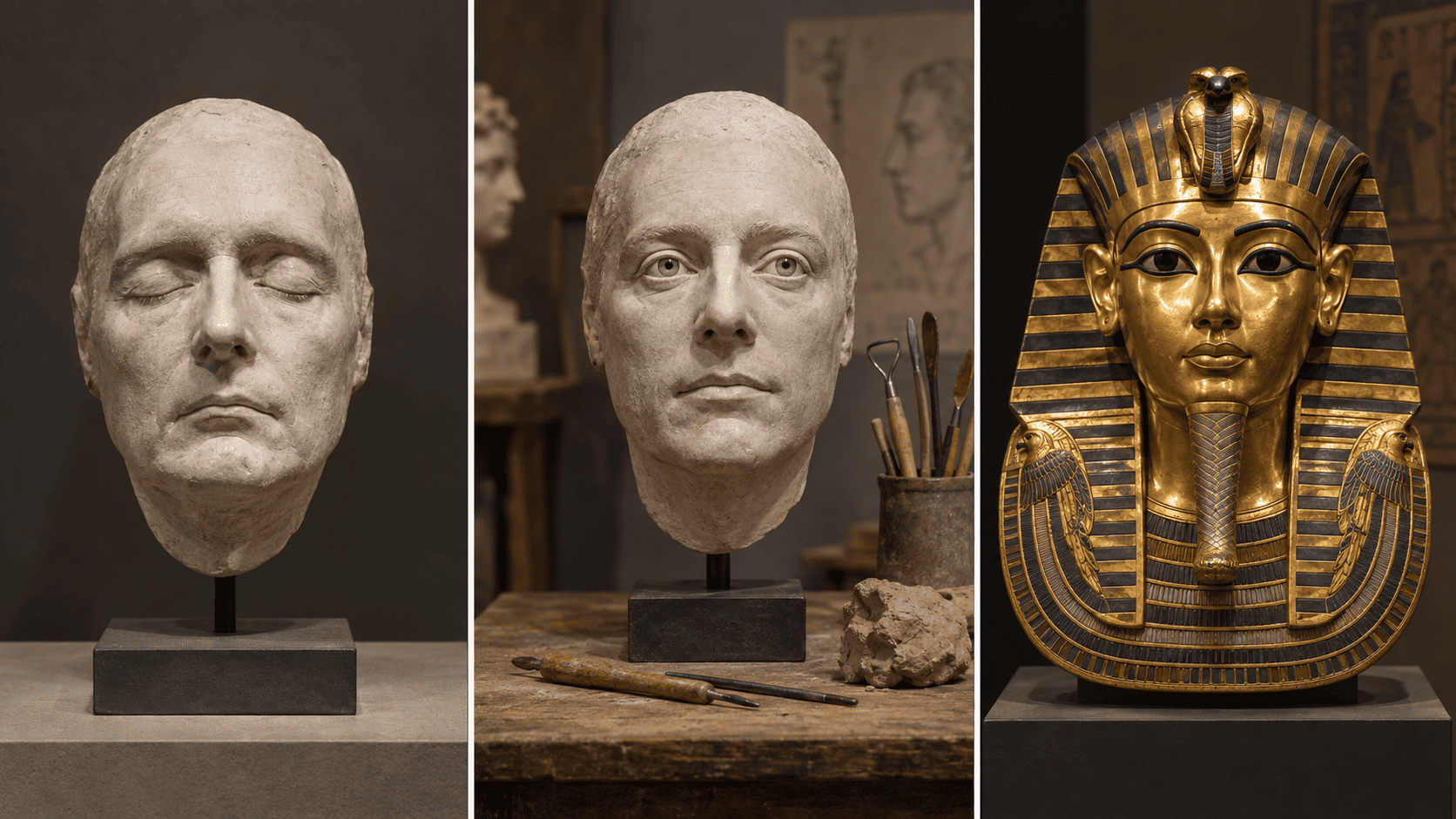
| Funerary mask | Created for burial; not necessarily cast directly from the face | Funerary, religious, symbolic, or protective purpose | Tutankhamun’s gold mask |
This distinction is particularly important when discussing ancient Egypt. Egyptian funerary masks belong to the broader history of preserving or representing the dead, but they are not equivalent to the direct post-mortem casts that became common in later European traditions.
How Were Death Masks Made?
Making a death mask required a mold to capture the shape of the face and a separate cast to reproduce it. Although techniques varied by period and workshop, plaster became one of the most practical materials because it could record fine surface detail and harden relatively quickly.
From the Facial Mold to the Finished Cast
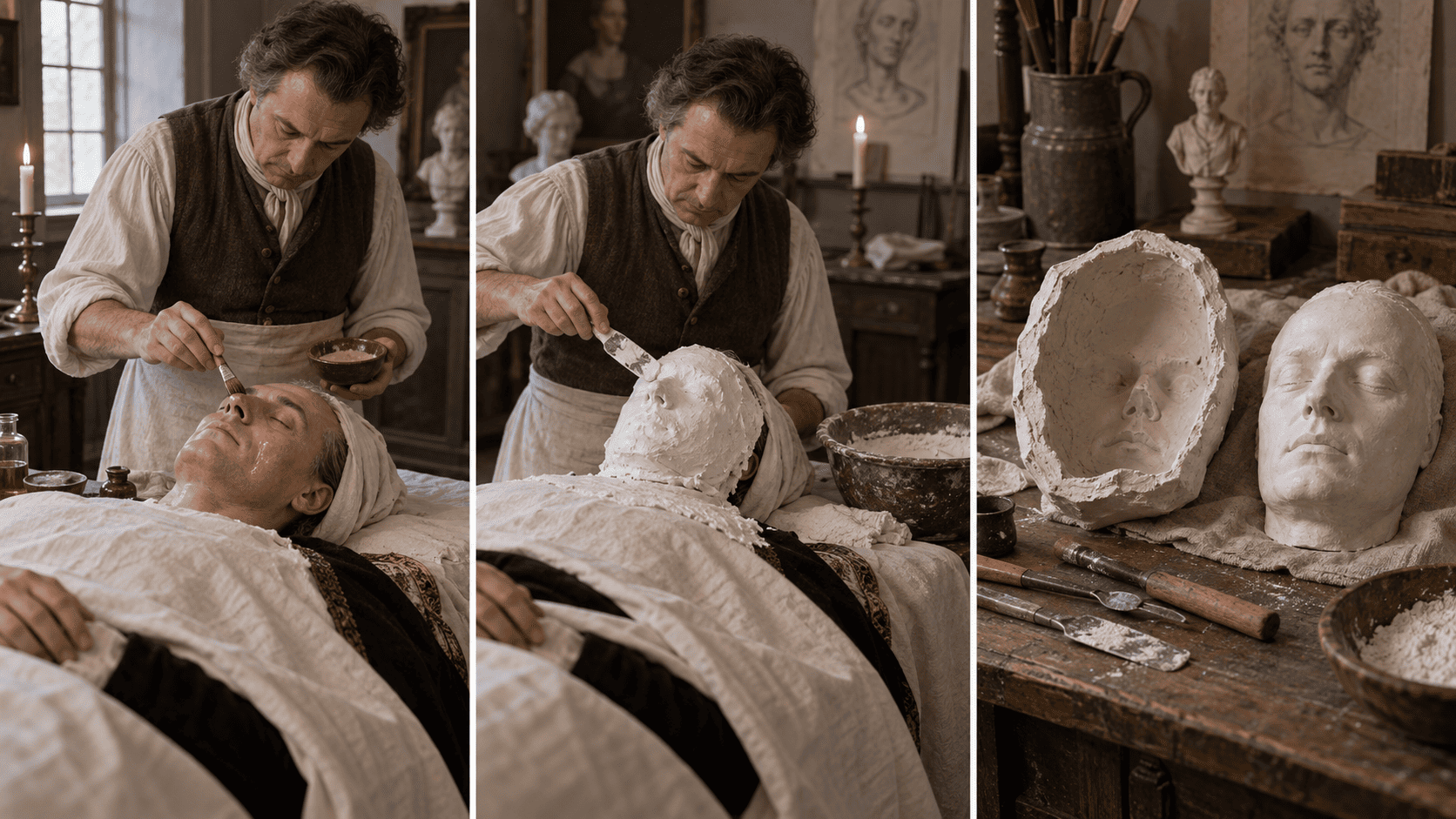
The face was first prepared so that the molding material would not adhere excessively to the skin or hair. A substance such as oil or grease could be applied, and exposed hair might be protected. Plaster or another molding material was then carefully placed over the face, sometimes in sections so it could be removed without damaging the impression.
The material touching the face produced a negative mold: features that projected outward on the person appeared recessed inside the mold. Plaster, wax, or another material could then be poured or pressed into that negative impression to create the positive cast recognizable as the death mask.
Plaster, Wax, and Bronze
Plaster casts were relatively inexpensive and could serve as master models. Additional versions might later be reproduced in wax or bronze, particularly when a mask became associated with an important historical figure. This helps explain why several museums may possess different casts of the same face: not every surviving example is necessarily the first mold or original cast made immediately after death.
Why Were Death Masks Made?
Memory and Mourning
One of the most straightforward purposes was remembrance. A death mask preserved an unusually direct physical record of someone who had died. For families and admirers, it could function as an intimate memorial at a time when photographs either did not exist or were not yet commonplace.
Models for Portraits, Busts, and Funeral Effigies
Artists also relied on death masks as working references. Sculptors preparing a tomb effigy, monument, portrait bust, or commemorative statue could study the proportions of the face long after burial. The cast did not determine the final artwork: artists could idealize features, restore the appearance of open eyes, adjust expressions, or combine the mask with portraits made during life.
Records Before Photography
Death masks also offered a form of documentation. Before photography became reliable and widely available, a cast could provide a three-dimensional record of facial structure. That practical value later extended into medical collections, anthropological study, and attempts at forensic identification.
The History of Death Masks
Ancient Funerary Masks: Egypt and Mycenae
Long before direct facial casting became widespread, ancient societies created masks for burial. Egyptian funerary masks are among the best known. Tutankhamun’s gold mask, created in the fourteenth century BCE, presented an idealized royal image and belonged to a funerary system concerned with status, identity, and the afterlife.
Mycenaean burials also produced metal face coverings, including the famous object traditionally known as the “Mask of Agamemnon.” Together, these objects show how ancient societies used representations of the human face within elaborate burial practices and ideas about the deceased.
Roman Imagines and Ancestor Portraits
Elite Roman families maintained realistic ancestral portraits known as imagines. Ancient descriptions associate these likenesses with wax and with public funeral ceremonies in which ancestors were represented during processions. They helped aristocratic families display lineage and political status.
However, Roman imagines should not automatically be described as post-mortem death masks. Evidence suggests that some likenesses may have been created during life. They belong to the related history of facial casting and ancestor representation, but not necessarily to the narrower definition of a cast made after death.
Medieval and Renaissance Death Casts
In medieval and Renaissance Europe, accurate representations of the dead became increasingly useful for royal and aristocratic funeral effigies and commemorative sculpture. One important surviving example is associated with Bernardino da Siena, who died in 1444 and is often identified in scholarly literature as the subject of the earliest securely documented and preserved European death mask.
Masks attributed to figures such as Dante are famous, but their dating and authenticity are less certain. This is why identifying the “oldest death mask” depends heavily on whether the object has a reliable history and can be shown to have been cast directly from the deceased.
The 18th and 19th Centuries
Death masks became particularly prominent during the eighteenth and nineteenth centuries. Famous writers, composers, political figures, criminals, and other public personalities were cast, collected, copied, and displayed. At the same time, life masks became popular as accurate references for artists.
The period also saw facial casts incorporated into emerging scientific collections. Some of those uses reflected legitimate interests in anatomy and identification, while others became entangled with theories that modern science has rejected.
Death Masks in Science, Phrenology, and Forensics
Phrenology and the Study of Faces
During the nineteenth century, collections of life and death casts were sometimes used by supporters of phrenology and related theories. Phrenologists claimed that the shape of the skull revealed intelligence, personality, morality, or criminal tendencies.
Phrenology is now recognized as a discredited pseudoscience. Its historical connection with death masks remains important, however, because it demonstrates how casts could move from memorial and artistic contexts into attempts to classify human behavior through physical appearance.
Identification Before Modern Photography
Death masks and post-mortem casts could also preserve the appearance of unidentified bodies or record the faces of criminals and other notable individuals. The twentieth-century death mask of American bank robber John Dillinger is a later example of how facial casts could enter forensic and law-enforcement collections even after photography had become widely established.
Famous Death Masks and the Stories Behind Them
Ludwig van Beethoven: Life Mask and Death Mask
Beethoven provides an unusually useful comparison because both a life mask and a death mask are associated with him. Sculptor Franz Klein produced a life mask in 1812 while Beethoven was alive. After the composer died in 1827, Josef Danhauser made his death mask.
The two objects demonstrate the distinction clearly: one records Beethoven during life, while the other preserves his facial features after death. Both later became important references for portraits and public memory of the composer.
Napoleon Bonaparte: A Famous Mask With a Complicated Provenance
Napoleon’s death mask is among the most reproduced examples in history, but its story is not as simple as a single surviving original. Multiple versions have been attributed to the physicians and attendants present on Saint Helena after Napoleon’s death in 1821, and historians have debated how the surviving casts relate to one another.
Francesco Antommarchi became particularly associated with versions of the mask, and later plaster and bronze copies circulated widely. Rather than treating every surviving “Napoleon death mask” as identical, provenance is essential for understanding when and how a particular version was produced.
L’Inconnue de la Seine: From Paris Legend to Resusci Anne
One of the most famous faces associated with death-mask culture belongs to the unidentified young woman known as L’Inconnue de la Seine. According to the popular story, her body was recovered from the Seine in Paris and a morgue worker, struck by her peaceful expression, arranged for a cast of her face.
That story is difficult to verify, and some researchers have questioned whether the face came from a drowned woman at all. What is certain is the extraordinary cultural afterlife of the image. Reproductions became popular in European homes and studios, and the face later inspired Resusci Anne, the CPR training mannequin used to teach lifesaving techniques around the world.
John Dillinger: A 20th-Century American Death Mask
John Dillinger’s death mask provides a striking twentieth-century American example. After the bank robber was killed in Chicago in 1934, a cast of his face was made at the Cook County Morgue roughly twelve hours after his death.
Copies of the mask later entered institutional and law-enforcement collections, including the FBI. The example demonstrates that death masks continued to be produced long after photography had become commonplace and that facial casts could still have forensic, documentary, and historical value.
Where Can You See Death Masks Today?
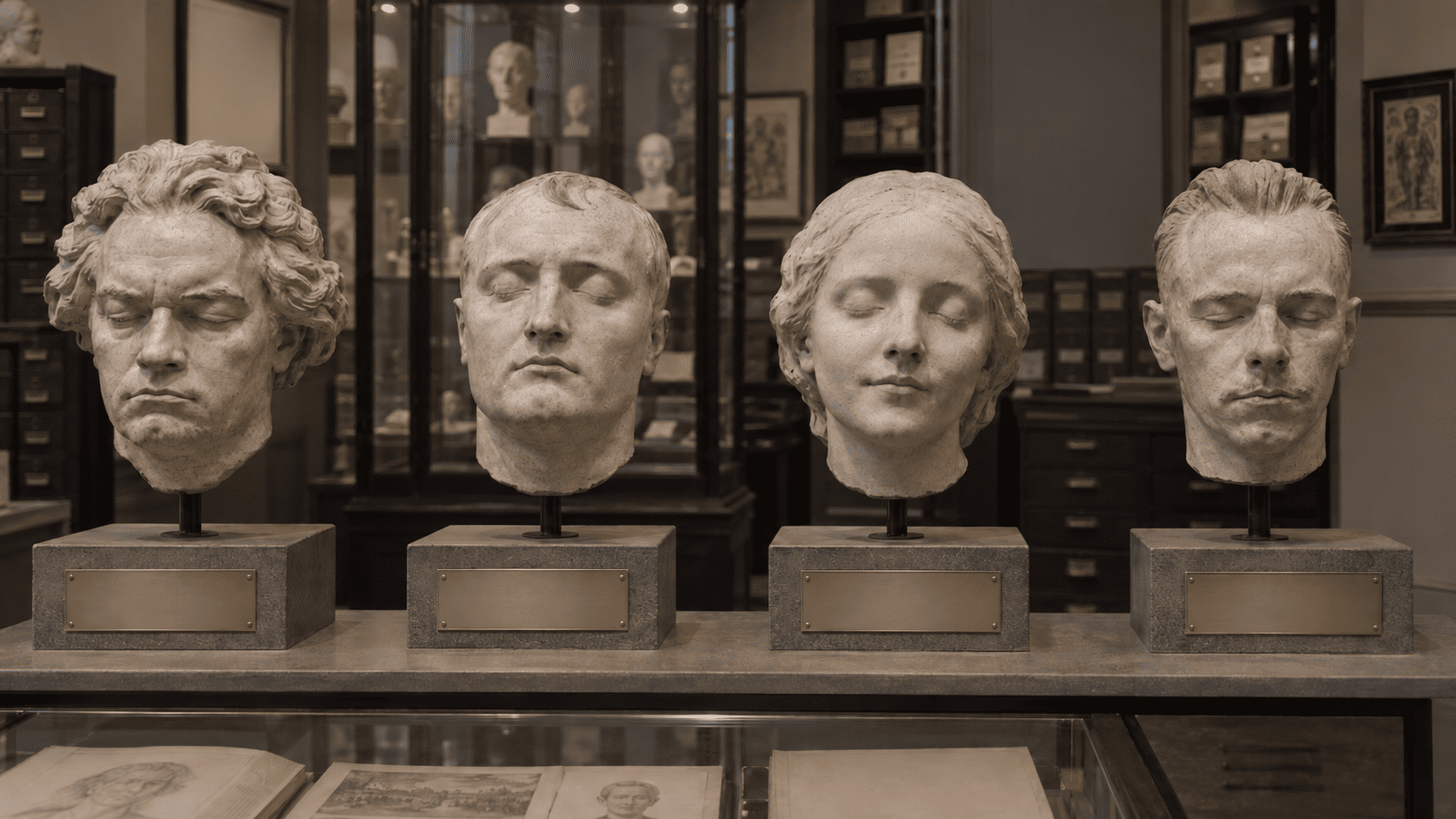
Death masks survive in museums, libraries, universities, medical collections, and historical archives. In the United States, Princeton University holds the Laurence Hutton Collection of Life and Death Masks, which contains more than one hundred casts of writers, politicians, actors, criminals, and other historical figures.
Major European collections also preserve death masks alongside portraits and sculpture. These archives are valuable not only because of the famous names represented but because casts can document changes in artistic practice, collecting, medicine, celebrity culture, and attitudes toward death.
Why Did Death Masks Become Less Common?
Photography and Changing Memorial Practices
Photography gradually removed one of the main practical reasons for making death masks. A photograph could preserve a person’s appearance during life more easily and without the physical process required to mold a face after death. Changing funeral practices and artistic conventions also reduced demand for post-mortem casts.
The decline was gradual rather than immediate. Death masks continued to be made well into the twentieth century, and older casts continued to be reproduced for museums, monuments, collectors, and study.
Are Death Masks Still Made Today?
Traditional death casting is now uncommon, but the idea has not disappeared. Artists continue to explore facial casting, mortality, and memorial portraiture, while digital scanning and three-dimensional imaging offer new ways to preserve a person’s features. Contemporary works may deliberately reference the historical death-mask tradition without serving the practical memorial purposes that once made these casts so widespread.
Japanese Mask Meanings: History, Symbolism, and Traditional Types

Hannya Mask Meaning: Symbolism, Colors, and Cultural Legacy

Traditional Indian Masks: Meanings, Rituals & Traditions
The History and Symbolism of Masks in Ancient Greek Theatre

Kitsune Mask Meaning, History, and Symbolism in Japan
Scold’s Bridle: History, Use & How the Punishment Worked
Explore More Mask Stories 👇