Kitsune Mask Meaning, History, and Symbolism in Japan
A kitsune mask is a Japanese fox mask whose meaning draws from several related traditions: fox folklore, the white fox messengers associated with Inari, Japanese performing arts, festivals, and modern popular culture. Depending on the context, the mask can suggest transformation, mystery, intelligence, sacred protection, or the unpredictable nature of the supernatural fox.
There is no single meaning shared by every kitsune mask, however. A theatrical fox mask, a festival mask, and a modern anime-inspired design do not necessarily represent the same thing. Understanding the kitsune mask meaning requires separating documented religious and theatrical traditions from folklore and newer interpretations. For other historically and culturally important examples, explore our guide to famous masks from different cultures.
Kitsune Mask at a Glance
- Kitsune means fox in Japanese.
- Fox imagery has an especially strong association with Inari, whose messengers are traditionally represented as white foxes.
- Japanese fox folklore also includes shapeshifting, deception, loyalty, supernatural power, and transformation.
- Historical fox masks are particularly well documented in Kyōgen theater.
- Modern mask colors and designs do not follow one universal ancient symbolism system.
What Does a Kitsune Mask Mean?
The meaning of a kitsune mask depends heavily on where and how it is used. At its most basic level, it represents the fox, an animal with an unusually complex place in Japanese religious imagery and folklore. The fox can appear as a sacred messenger, a clever shapeshifter, a dangerous supernatural being, a loyal companion, or an ambiguous figure that moves between the human and spirit worlds.
Inari’s Messenger and Sacred Associations
One of the strongest cultural associations behind the Japanese fox mask is Inari, a major kami traditionally connected with rice, agriculture, prosperity, and later commercial success. Foxes are closely associated with Inari shrines, but an important distinction is often lost in popular explanations: Inari is not a fox. Foxes function as messengers or attendants of Inari.
This religious association helps explain why some kitsune imagery can suggest prosperity, protection, or sacredness. Those meanings, however, come from a particular Inari context and should not automatically be applied to every fox mask.
Transformation, Mystery, and the Fox’s Dual Nature
Japanese folklore also portrays foxes as supernatural beings capable of transformation. Stories frequently describe foxes assuming human form, sometimes to deceive people and sometimes to form genuine relationships with them. This combination of intelligence, concealment, transformation, and uncertainty is why modern kitsune masks often evoke mystery, hidden identity, adaptability, and change.
Why the Meaning Depends on Context
A kitsune mask worn during a fox-themed festival may emphasize community tradition and folklore. A historical theatrical mask may represent a specific fox character. A decorative mask sold today may borrow the visual language of both without having a ritual function at all. For that reason, statements such as “a kitsune mask always means protection” or “every fox mask represents Inari” oversimplify a much more varied tradition. For a broader comparison with other traditional types, see our guide to Japanese mask meanings.
How Did the Fox Become Sacred in Japan?
The cultural history behind the kitsune mask is older than the surviving masks themselves. Foxes appeared in Japanese stories and religious traditions long before the modern decorative fox mask became internationally recognizable.
Early Fox Folklore and Shapeshifting Stories
Supernatural fox traditions developed across East Asia, and Japanese folklore incorporated and reshaped many ideas about foxes over centuries. In Japanese tales, foxes could display extraordinary intelligence, longevity, magical abilities, and the power to disguise themselves as humans.
Some stories portray them as troublesome or deceptive. Others describe foxes forming marriages, rewarding kindness, keeping promises, or helping human beings. This variety is essential to understanding kitsune symbolism: the fox is not simply good or evil.
The Fox’s Association With Inari
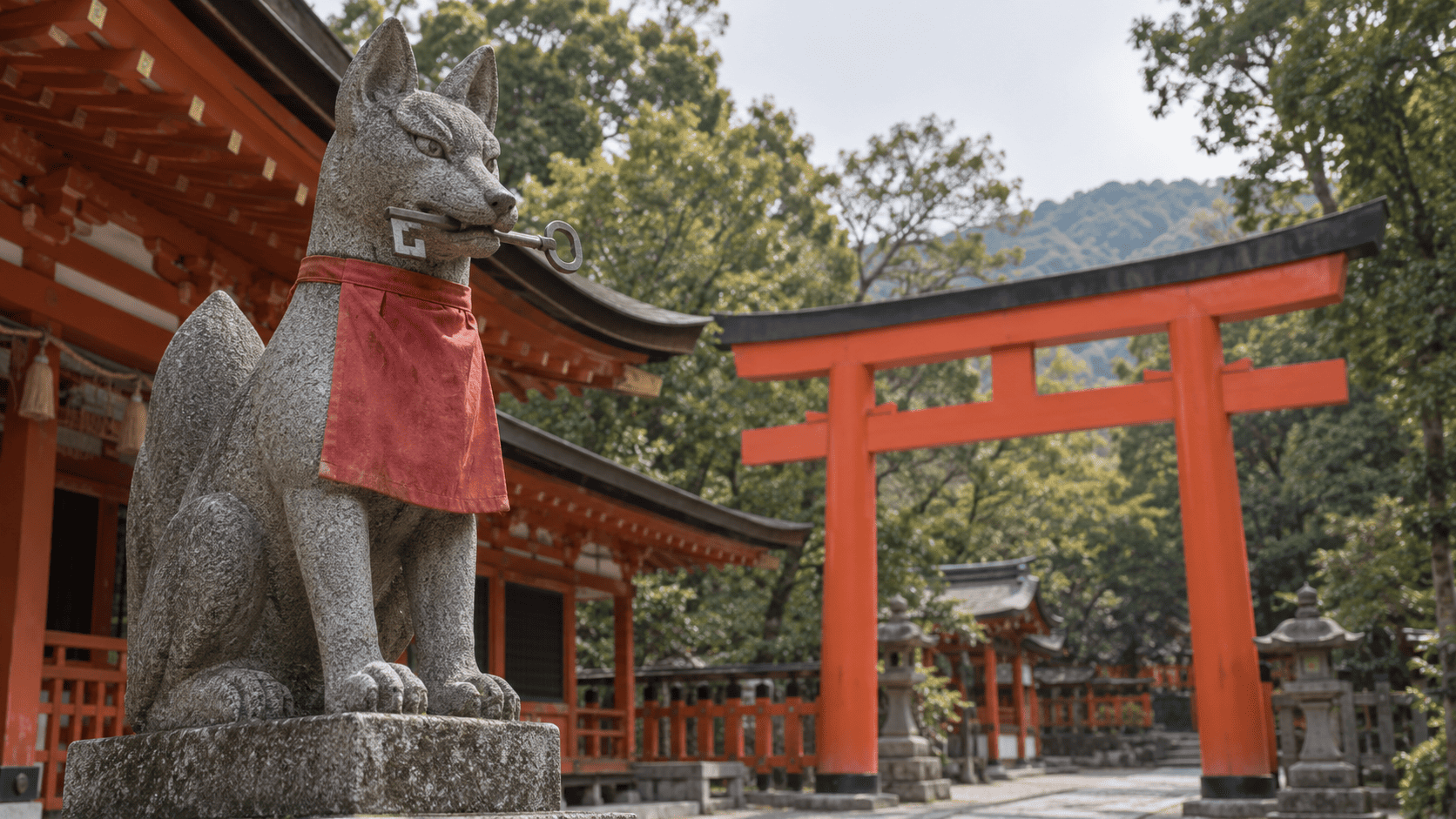
The connection between foxes and Inari became one of the most enduring fox traditions in Japan. Visitors to Inari shrines commonly encounter pairs of fox statues serving as symbolic guardians or messengers. Some hold objects such as keys, jewels, scrolls, or sheaves connected with the shrine’s religious symbolism.
This relationship contributed greatly to the sacred image of the fox. Yet the shrine fox and the supernatural fox of folklore should not be treated as identical characters. Religious traditions surrounding Inari and folkloric stories about shapeshifting foxes overlap, but they developed in different contexts.
White Foxes at Inari Shrines
Inari’s fox messengers are especially associated with the white fox. They may be described as invisible or spiritual white foxes rather than ordinary animals. This gives white fox imagery a much stronger historical basis than many of the color meanings assigned to commercial kitsune masks today.
A white fox design can therefore visually recall one of the most important religious fox traditions in Japan, especially when it appears alongside other imagery associated with Inari.
Kitsune in Japanese Folklore
The mask cannot be understood through shrine symbolism alone. Much of its modern appeal comes from the broader world of kitsune folklore, where foxes appear as intelligent supernatural beings whose motives are not always obvious.
Benevolent Foxes, Wild Foxes, and the Zenko/Nogitsune Distinction
Modern explanations sometimes divide supernatural foxes into zenko, benevolent foxes associated with Inari, and nogitsune, wild foxes that are more independent or troublesome. The distinction can be useful for explaining contrasting fox traditions, but it should not be treated as a complete historical taxonomy covering every kitsune story ever recorded.
Japanese fox traditions vary by period, region, religious context, and storyteller. The recurring pattern is not a rigid list of fox “types,” but the idea that supernatural foxes could interact with humans in many different ways.
Nine-Tailed Foxes and Tamamo-no-Mae
The famous nine-tailed fox is part of a broader East Asian tradition rather than an idea that originated exclusively in Japan. Over time, Japanese storytelling connected the motif with figures such as Tamamo-no-Mae, the legendary woman later revealed in expanded versions of the story to be a powerful fox spirit.
Popular culture often treats the number of tails as a simple ranking system in which more tails automatically mean greater age or power. Historical folklore is more complicated. The nine-tailed fox became an especially recognizable supernatural image, but there was never one universal rule governing the number of tails on every kitsune.
Fox-Wife Stories and Transformation
Another important group of stories involves foxes who take human form and become wives or companions. The story of Kuzunoha is a well-known example of the fox-wife tradition. Such stories can combine affection, concealment, loyalty, separation, and supernatural transformation.
These narratives help explain why transformation is so strongly connected with the modern cultural meaning of the kitsune mask. The mask hides one face while presenting another, making it a natural visual symbol for a creature famous for crossing boundaries between identities.
Kitsune Masks in Japanese Theater and Performance
Fox masks have a documented history in Japanese performing arts, where they can represent specific supernatural characters and traditions. Historical evidence is especially clear in Kyōgen, the comic dramatic form closely associated with Noh performance culture.
Kyōgen and the Fox Mask in Tsurigitsune
Surviving museum examples from Japan’s early modern period identify Kitsune as a Kyōgen mask type. One important play is Tsurigitsune, also known through the fox character Hakuzōsu.
In the story, a fox disguises itself as a Buddhist priest in an attempt to persuade a hunter to stop killing foxes. The performance requires the actor to convey the tension between the fox’s disguise and its animal nature, making the mask central to the character’s identity.
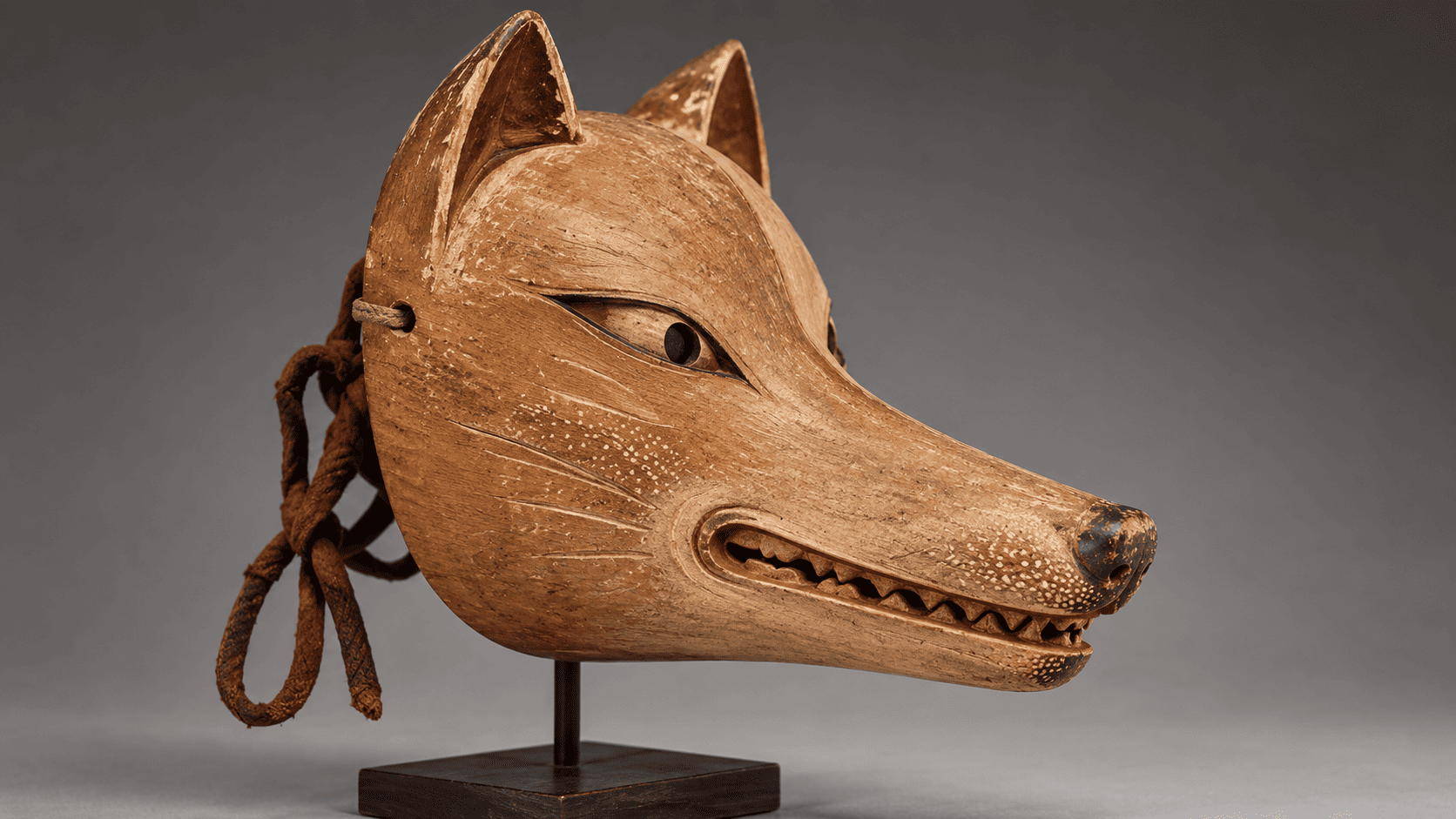
Traditional theatrical fox masks could be carved from wood and carefully painted. Historical theatrical masks belonged to specific performance traditions, while festival, folk, decorative, and modern fox masks developed in other settings and can differ considerably in material, shape, markings, and purpose.
Fox Characters in Noh
Noh also includes supernatural beings and stories involving fox-related themes, and masks are fundamental to many Noh roles. However, it is more accurate to distinguish this broader theatrical environment from the specifically documented Kyōgen Kitsune mask rather than using “fox Noh mask” as a universal historical name for every kitsune mask.
Kagura and Regional Performance Traditions
Fox imagery can also appear in regional performing traditions, including forms of kagura and local festival entertainment. Practices differ considerably from one region and performance tradition to another, so these examples should not be interpreted as evidence of one standardized national kitsune-mask ritual.
Kitsune Masks at Festivals and Shrines
Today many visitors encounter kitsune masks through festivals, shrine districts, souvenir shops, and public celebrations. These settings have helped transform the fox mask from a specialized theatrical and folkloric image into one of the most recognizable symbols of Japanese visual culture.
The Ōji Fox Parade
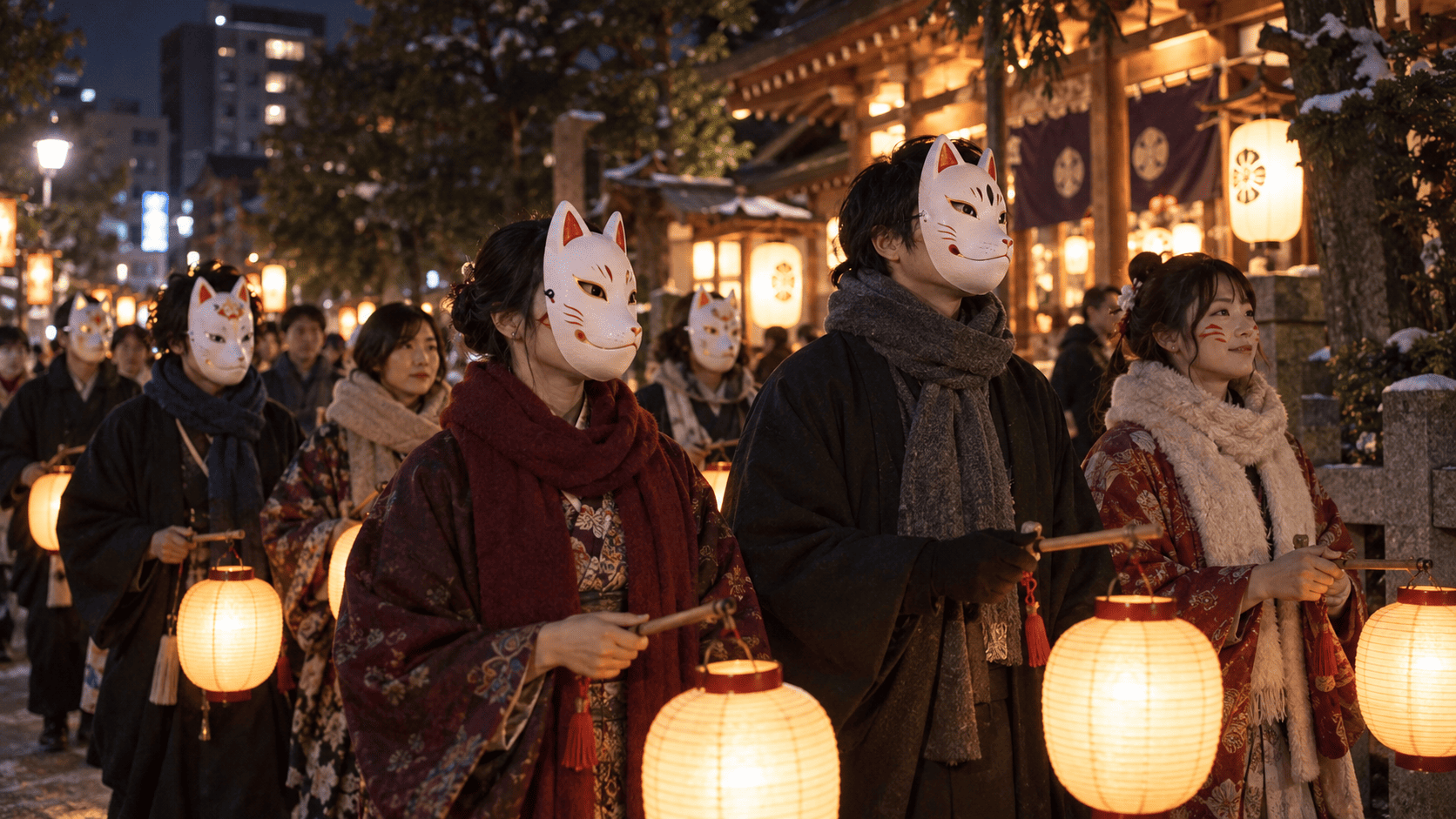
A particularly relevant example is Tokyo’s Ōji Fox Parade, where participants use fox masks, makeup, lanterns, and costume to recreate a local fox legend associated with New Year. The modern parade began in the 1990s, drawing inspiration from older stories in which foxes were said to gather before visiting the nearby shrine.
The parade offers a clear modern example of kitsune masks being worn as part of a living public celebration connected with local fox folklore.
Inari Shrines and Festival Fox Imagery
Fox imagery is naturally prominent around Inari shrines, and modern festivals or events connected with fox legends may include wearable masks. However, a kitsune mask should not automatically be described as a ritual object required for Inari worship. Fox statues and messenger symbolism are central to the shrine tradition; wearable masks have additional theatrical, festival, artistic, and commercial histories.
What Do Kitsune Mask Colors and Markings Mean?
Color is one of the areas where modern explanations of the Japanese kitsune mask most often become misleading. Online guides frequently present fixed charts in which white means purity, pink means love, black means evil, blue means wisdom, and gold means wealth. There is no universal historical Japanese system assigning all kitsune-mask colors meanings in that way.
White and Red Kitsune Masks
White has the strongest traditional fox association because Inari’s messengers are linked with spiritual white foxes. White masks decorated with red markings can therefore evoke familiar Inari and shrine aesthetics. Red itself also appears prominently in Japanese religious architecture and auspicious visual culture.
That connection still does not establish a rule that every individual line, swirl, or red marking on every fox mask has a fixed religious meaning. Designs differ among theatrical masks, festival masks, craftspeople, commercial products, and contemporary artists.
Kitsune markings around the eyes, cheeks, forehead, or muzzle are often used to emphasize the fox’s facial features and give the mask a more expressive or supernatural appearance. Their placement and shape can vary substantially between historical, festival, and contemporary designs. Unless a specific tradition or artist assigns a documented meaning to a particular mark, it is safer not to interpret every line or pattern as an independent symbolic code.
Black, Gold, and Modern Designs
Black, gold, pink, blue, neon, cracked, metallic, and multicolored kitsune masks are widespread in contemporary art, fashion, cosplay, and online retail. Their meanings usually depend on the artist, character, brand, or fictional setting rather than an ancient universal color code.
A black kitsune mask, for example, is often used in modern designs to create a darker, mysterious, dramatic, or supernatural appearance. These associations are primarily artistic or fictional rather than evidence of one historically documented Japanese meaning for black fox masks.
| Mask Design | Historically Grounded Association | Important Caution |
|---|---|---|
| White | Strong visual connection with Inari’s white fox messengers | Not every white mask is a sacred or ritual object |
| White with red markings | Can evoke Inari and shrine aesthetics | Individual markings do not follow one universal symbolic code |
| Black | Common in modern dramatic, mysterious, or supernatural designs | No single universal traditional meaning is documented |
| Gold | Often used in modern decorative and dramatic designs | No universal traditional meaning applies to every mask |
| Pink, blue, neon, or multicolor | Common in contemporary art, cosplay, and pop culture | Meanings are usually modern or design-specific |
The Kitsune Mask in Modern Culture
Anime, Manga, Games, and Cosplay
The kitsune mask has become internationally recognizable through anime, manga, video games, tattoos, fashion, and cosplay. Modern creators often use the mask because its traditional associations with transformation, supernatural identity, secrecy, and fox folklore can be understood visually even without a lengthy explanation.
Contemporary fictional works are free to create their own symbolic systems, so a mask may represent a clan, magical ability, hidden identity, or individual character rather than any historical Japanese belief. These fictional meanings should be distinguished from the religious and folkloric traditions that inspired the imagery.
From Traditional Symbol to Global Icon
Modern kitsune masks are made from wood, paper, resin, plastic, fabric, and other materials. Some imitate historical forms while others dramatically redesign the fox face for decorative use. This adaptability has helped the mask travel far beyond Japan while retaining an immediately recognizable connection with Japanese fox imagery.
The result is not the disappearance of tradition but the coexistence of several meanings: religious associations surrounding Inari, supernatural fox folklore, historical performance, festival culture, and modern creative interpretation.
Frequently Asked Questions About Kitsune Masks
What Is the Japanese Fox Mask Called?
A Japanese fox mask may be referred to as kitsune-men (狐面), literally a fox mask. Terminology can vary depending on theatrical, regional, artistic, or commercial context.
Are Kitsune Masks Religious or Decorative?
They can be either, depending on context. Fox imagery has important religious associations with Inari, while historical fox masks are documented in theater and masks are also worn in festivals. Many kitsune masks produced today are decorative, collectible, fashion-related, or intended for cosplay and have no formal ritual function.
When Did Kitsune Masks First Appear?
There is no securely established date for a single “first kitsune mask.” Fox folklore and Inari-related fox traditions are much older than many surviving masks. Museum collections preserve clearly identified Kyōgen Kitsune masks from Japan’s early modern period, showing that theatrical fox masks were established by that time. Claims that all kitsune masks originated in one specific ancient period should therefore be treated cautiously unless supported by direct evidence.
Is It Okay or Respectful to Wear a Kitsune Mask?
Yes, wearing a kitsune mask is generally okay and is not inherently disrespectful. Fox masks are sold and worn in contemporary Japanese festival, artistic, souvenir, and entertainment contexts. Respect depends largely on how the imagery is used. Treating every kitsune mask as an exotic sacred object, inventing religious meanings for modern designs, or mocking living religious traditions can create a misleading impression of Japanese culture. Understanding the context behind the mask is the best way to appreciate it responsibly.
Japanese Mask Meanings: History, Symbolism, and Traditional Types
Hannya Mask Meaning: Symbolism, Colors, and Cultural Legacy
Traditional Indian Masks: Meanings, Rituals & Traditions
The History and Symbolism of Masks in Ancient Greek Theatre

Death Masks: History, Purpose, and Famous Examples
Scold’s Bridle: History, Use & How the Punishment Worked
Explore More Mask Stories 👇