The History and Symbolism of Masks in Ancient Greek Theatre
Masks in Greek theatre were essential parts of performance, not decorative accessories. Across ancient Greek drama, actors and chorus members wore masks to establish characters, allow a small cast to portray multiple roles, and make different identities recognizable in large open-air theaters. Because male actors also played female characters, masks worked together with costume, voice, and movement to signal age, gender, status, and dramatic type.
Their use developed in close association with festivals honoring Dionysus, with different conventions in tragedy, comedy, and satyr drama. No securely identified original stage masks survive, so historians reconstruct their appearance and use from ancient art, archaeological objects, and written sources. For other historically important examples, explore our guide to famous masks from different cultures.
Why Were Masks Used in Ancient Greek Theatre?
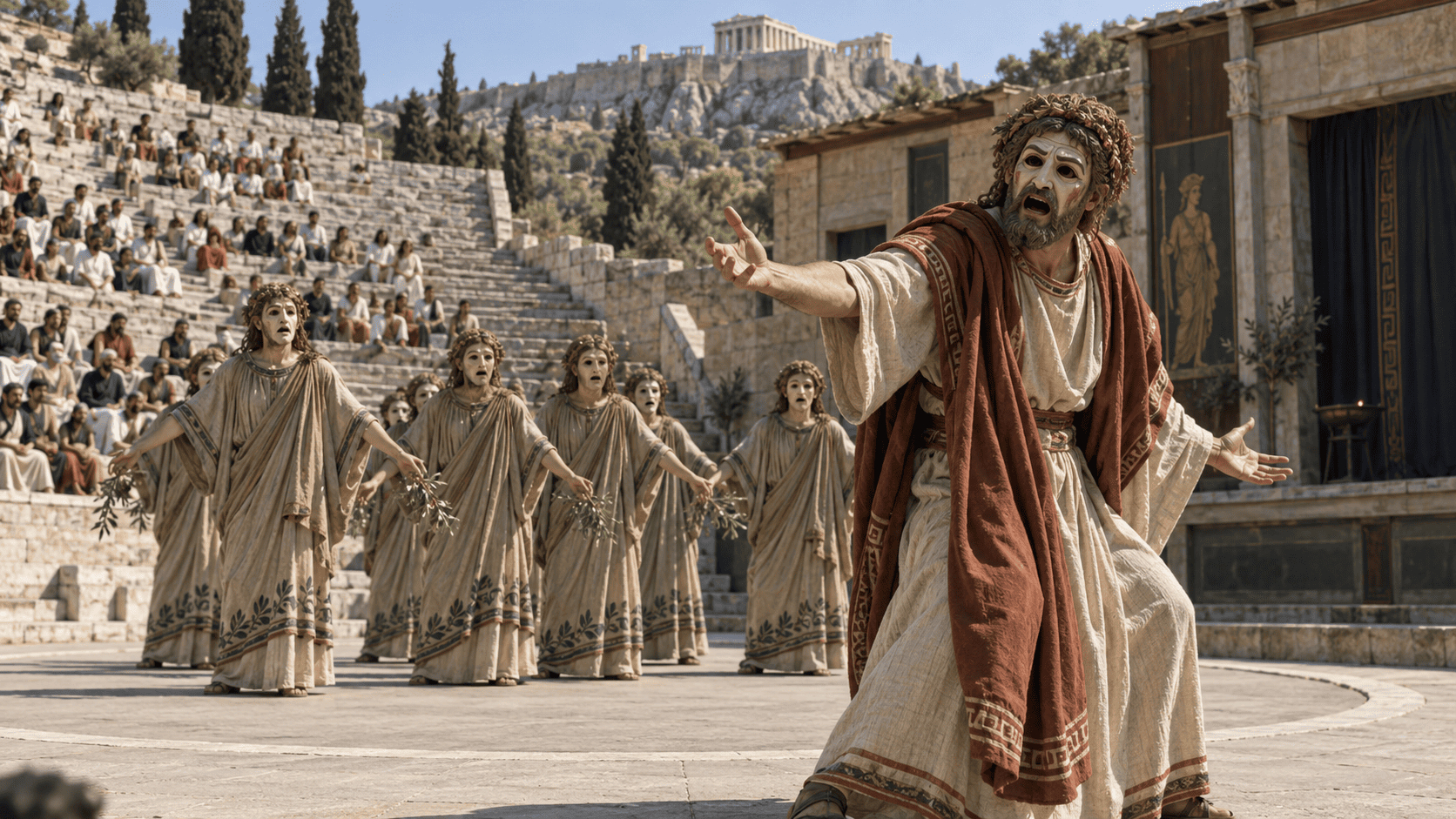
Masks served several practical and theatrical purposes in ancient Greek performance. They transformed the visible identity of the performer, helped audiences distinguish characters, and made it possible for one actor to appear in more than one role during the same play. They were part of a larger performance system in which costume, gesture, voice, music, and chorus worked together.
Character Transformation and Multiple Roles
Greek drama used a limited number of speaking actors, so the same performer could play several characters. A change of mask and costume gave the audience an immediate visual signal that a new character had entered. The mask therefore did more than hide the actor’s face: it supplied a theatrical face that identified the role being performed.
Different masks could indicate broad characteristics such as youth or old age, male or female identity, social position, temperament, or dramatic type. The audience then learned the individual character through the actor’s words, movement, costume, and place in the story.
Male Actors and Female Characters
Women did not perform the speaking roles of Classical Athenian drama, so male actors also portrayed female characters. Masks were one part of the visual transformation required for these roles. Together with costume, hairstyle, posture, and vocal technique, they helped create a recognizable female character without requiring the performer’s own face to resemble the role.
Chorus Masks and Collective Identity
The chorus also performed masked. In tragedy, comedy, and satyr drama, chorus members represented a group rather than a series of unrelated individuals: elders, women, sailors, captives, satyrs, or another collective appropriate to the play. Coordinated masks and costumes helped establish that shared identity, while synchronized movement and song reinforced the chorus as a dramatic unit.
Visibility, Gesture, and Large Theaters
Ancient Greek theaters could accommodate large audiences, and spectators seated far from the orchestra could not depend on subtle facial expression. A mask presented a stable visual type that remained readable at a distance. Gesture, stance, costume, rhythm, speech, song, and the audience’s knowledge of theatrical conventions all contributed to character recognition.
Masks and costumes in Greek theatre worked as a single visual system. Clothing could help indicate gender, status, occupation, or mythological identity, while the mask supplied the character’s visible face. The actor’s body and movement completed the stage image, so the meaning of a mask cannot be separated entirely from the costume and performance around it.
Did Greek Masks Amplify the Actor’s Voice?
The common claim that Greek theater masks functioned as built-in megaphones is stated with more certainty than the surviving evidence allows. The mouth opening obviously allowed the actor to speak, and modern experiments with reconstructed masks suggest that mask shape can alter how sound radiates and may strengthen some frequencies. However, no original stage masks survive for direct acoustic testing, and the effect depends on the reconstruction and performance environment.
It is therefore more accurate to say that masks may have affected vocal projection or resonance than to state that they were deliberately engineered as amplifiers. The acoustics of surviving Greek theaters also make it unnecessary to explain audibility through the mask alone.
The Origins and Symbolism of Masks in Greek Theatre
The exact beginnings of theatrical masking in Greece are difficult to reconstruct, but drama developed in close connection with festivals honoring Dionysus. Ancient traditions linked early theatrical innovation with figures such as Thespis, yet those accounts were recorded later and should not be treated as a precise documentary record of when the first stage mask appeared.
Dionysus and the Festival Context
In Athens, tragedy, comedy, and satyr drama became part of civic festivals connected with Dionysus. Theatrical competition, religious observance, music, poetry, dance, and public life met in the same setting. Masks helped performers assume the identity of heroes, gods, women, foreigners, slaves, comic stereotypes, and supernatural beings within specific plays.
Prosopon: The Greek Word for Face and Theatrical Mask
The Greek term prosōpon could mean “face” or “countenance” and, in theatrical contexts, the face presented by the performer. This matters because the modern English word “mask” often emphasizes concealment. In Greek performance, putting on another face also created a visible identity: the performer became recognizable as another person or dramatic type.
What Did Ancient Greek Theatre Masks Look Like?
Greek theatrical masks were designed as complete stage faces rather than the small decorative eye masks familiar from later European masquerade traditions. Ancient representations suggest forms that covered the face and often integrated hair or a head covering, creating a complete visual identity for the character.
Helmet-Like Form, Hair, Eyes, and Mouth
Later Greek evidence describes a common helmet-like form secured around the head or under the chin. Openings at the eyes allowed the actor to see, while the mouth opening allowed speech and song. Hair and beards could be attached to the mask or integrated with the head covering. Painted details could distinguish complexion, age, brows, wrinkles, and other character traits.
Age, Gender, Status, and Character
A theatrical mask did not need to reproduce an individual portrait. Its purpose was to make a recognizable stage character. A young woman, an old citizen, a slave, a courtesan, a hero, or a comic old man could be identified through a combination of mask, hair, costume, and performance convention. In later comedy, especially New Comedy, surviving terracotta figures show increasingly recognizable stock types.
Classical vs. Hellenistic Mask Design
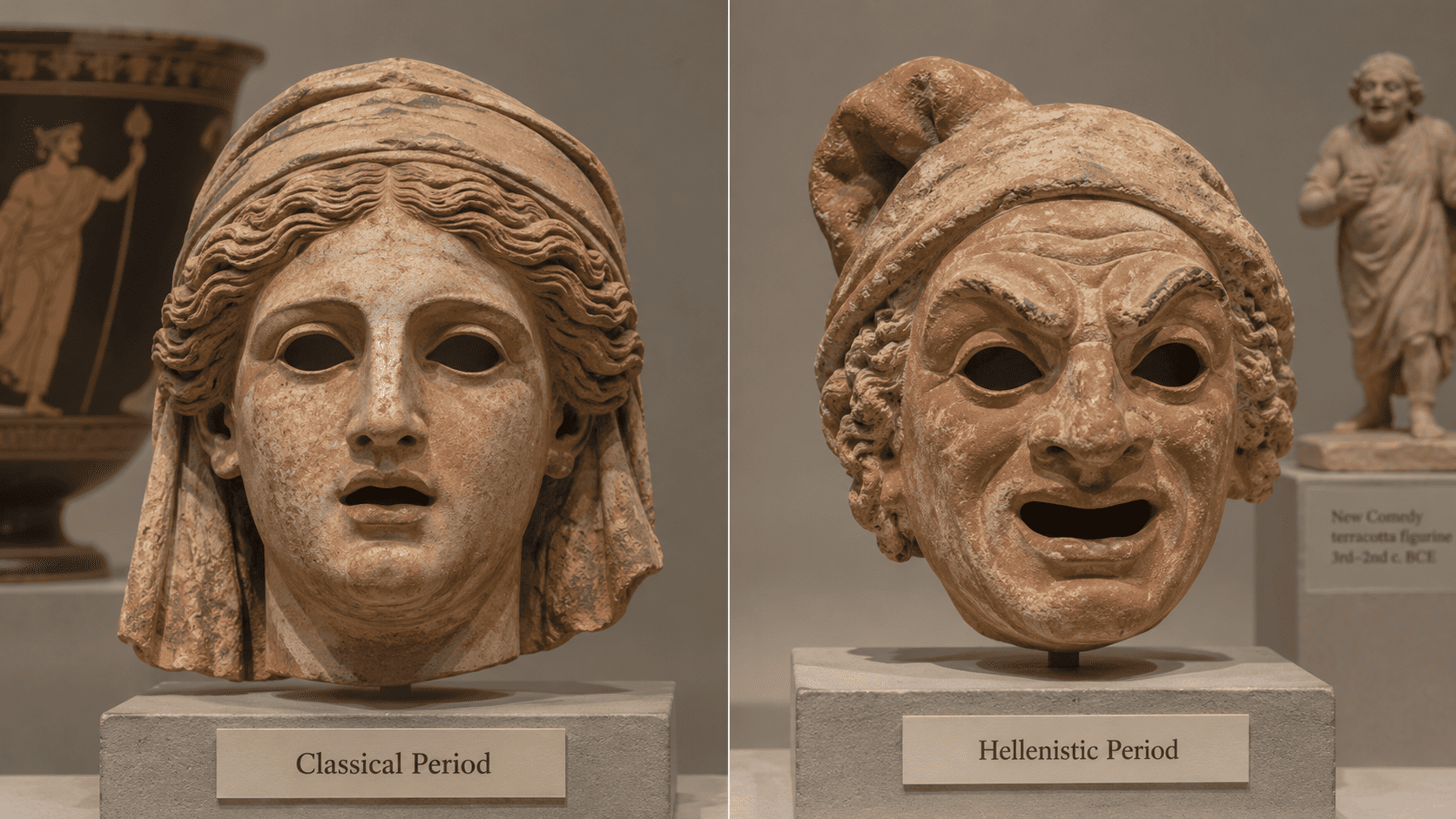
It is important to separate evidence from different periods. Fifth-century BCE vase paintings bring us closest to the Classical performances of Aeschylus, Sophocles, Euripides, and Aristophanes. Their theatrical imagery belongs to the world of Classical tragedy, comedy, and satyr drama.
Fourth-century and Hellenistic terracotta masks and figurines document later developments, especially the growing standardization of comic character types in New Comedy. Roman copies and later literary descriptions preserve additional information but belong to still later stages of theatrical history. Keeping these chronological layers separate prevents later mask styles from being treated as exact records of every fifth-century BCE production.
Types of Masks in Greek Theatre
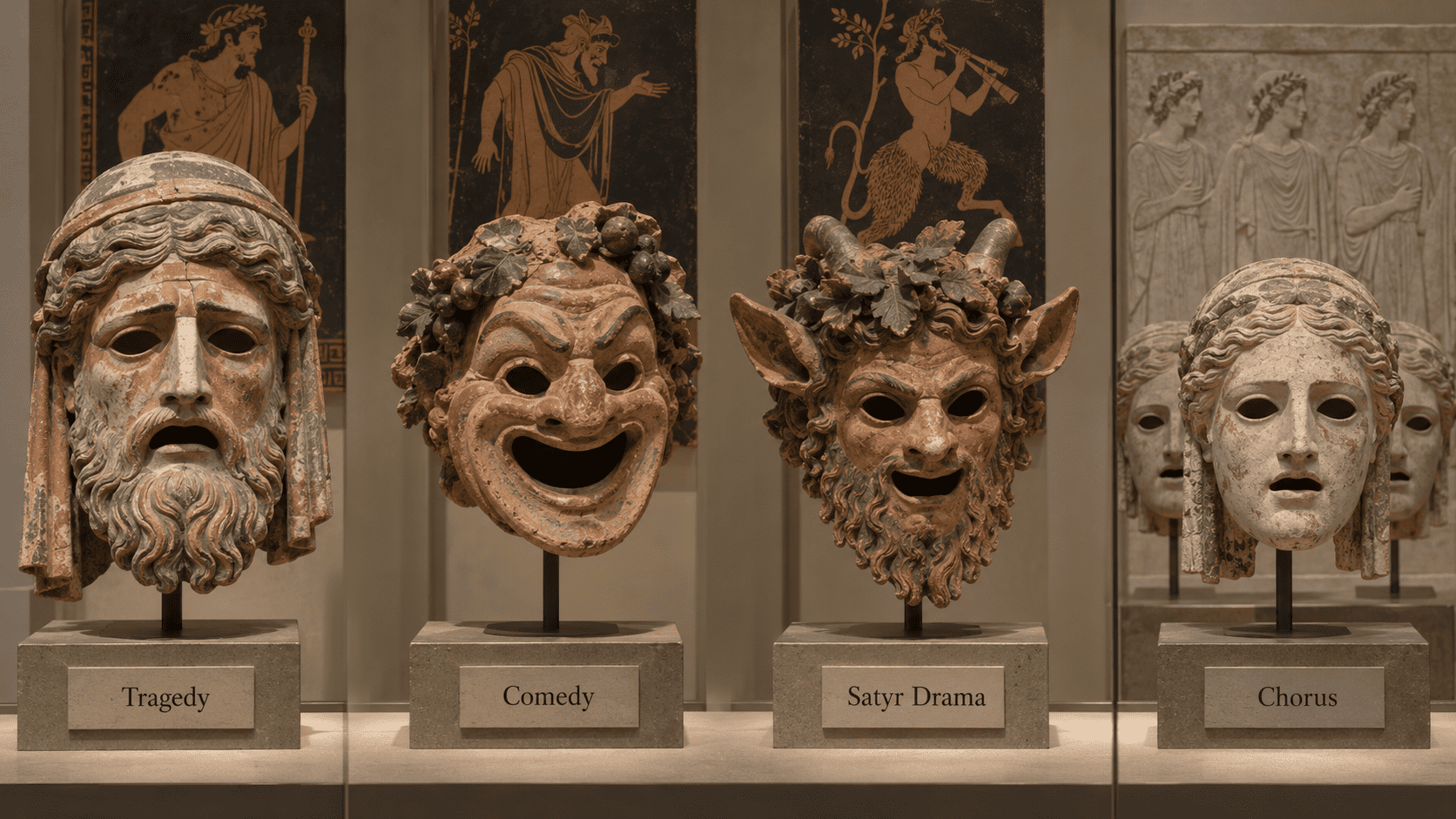
Ancient Greek theater used many character masks across tragedy, comedy, and satyr drama, while the chorus also appeared masked. The types and visual conventions changed over time and according to dramatic genre.
Tragedy Masks
Tragic masks identified roles such as rulers, heroes, queens, young people, old people, messengers, gods, and supernatural figures. Visual distinctions in age, hair, complexion, and status helped establish the character before the actor’s speech and movement supplied the individual dramatic identity. The emotional force of tragedy came from the interaction of the mask with poetry, voice, gesture, posture, and the situation of the play.
Comedy Masks
Comedy developed more overtly exaggerated visual conventions. Evidence associated with Old Comedy includes grotesque faces, caricature, padded costumes, and deliberately excessive physical features that supported parody, fantasy, and social satire.
By the fourth century BCE and the development of New Comedy, theatrical art increasingly shows recognizable stock characters such as old men, slaves, young men, courtesans, and other social types. Differences among these masks could distinguish variations within the same broad category, creating a sophisticated visual vocabulary for comic characters.
Satyr Masks
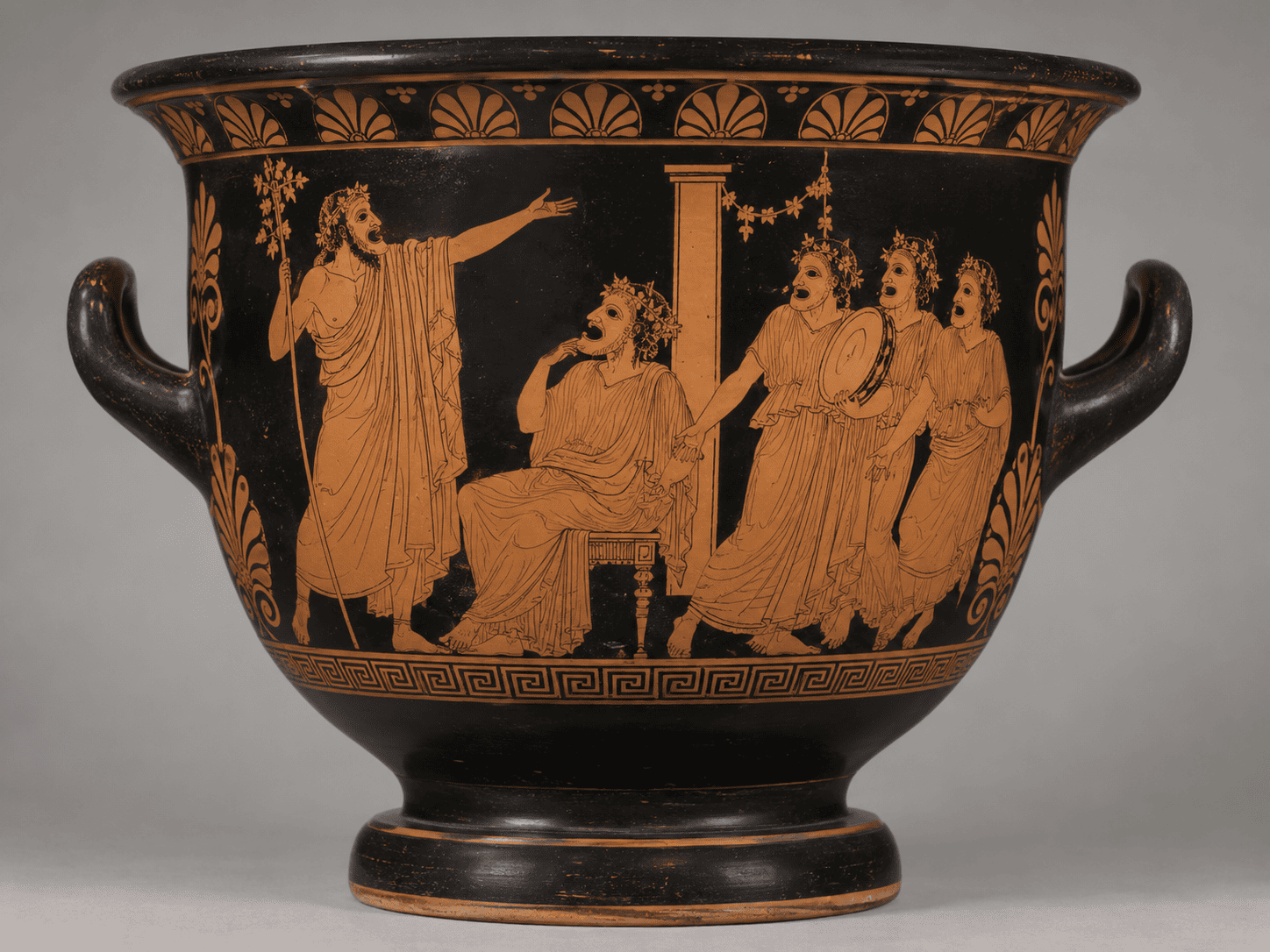
Satyr drama combined heroic myth with a chorus of satyrs, followers of Dionysus characterized by animal-like and rustic features. Their masks and costumes made the chorus visibly nonhuman and immediately distinguished the satyr play from tragedy. The famous Pronomos Vase is especially valuable because it shows performers associated with a satyr production together with their masks and costumes.
| Mask Type | Typical Context | Visual Approach | Main Dramatic Function |
|---|---|---|---|
| Tragedy | Tragic drama | Character-dependent, including youthful, aged, royal, or supernatural roles | Identify dramatic role and status |
| Comedy | Old, Middle, and New Comedy | Often exaggerated; later increasingly standardized by character type | Identify comic character or social type |
| Satyr | Satyr drama | Animal-like or rustic satyr features | Identify the Dionysian satyr chorus |
| Chorus | Tragedy, comedy, and satyr drama | Coordinated with the group represented | Create collective identity |
How Were Greek Theatre Masks Made?
Greek theatre masks were probably made from lightweight, perishable materials rather than the stone or terracotta objects that survive in museums. Evidence and later descriptions point to materials such as fabric or linen, leather, lightweight wood, prepared surface layers, wool, and paint, but no single construction method can be proven for every Classical-period mask.
Materials and Construction
Reconstructed accounts describe fabric shaped into a face and stiffened or prepared for painting, with wool or other fibers used for hair and beards. Leather straps or related fastenings may have helped secure a helmet-like mask around the head. The goal was a wearable stage object that could combine the face, hair, and head covering into one recognizable character image.
The Skeuopoios: The Mask and Prop Maker
A specialist known as the skeuopoios was associated with producing theatrical equipment, including masks and stage properties. The existence of a specialist maker emphasizes that masks belonged to a larger system of costume, props, and visual design prepared for performance rather than being simple improvised coverings.
Why No Original Stage Masks Survive
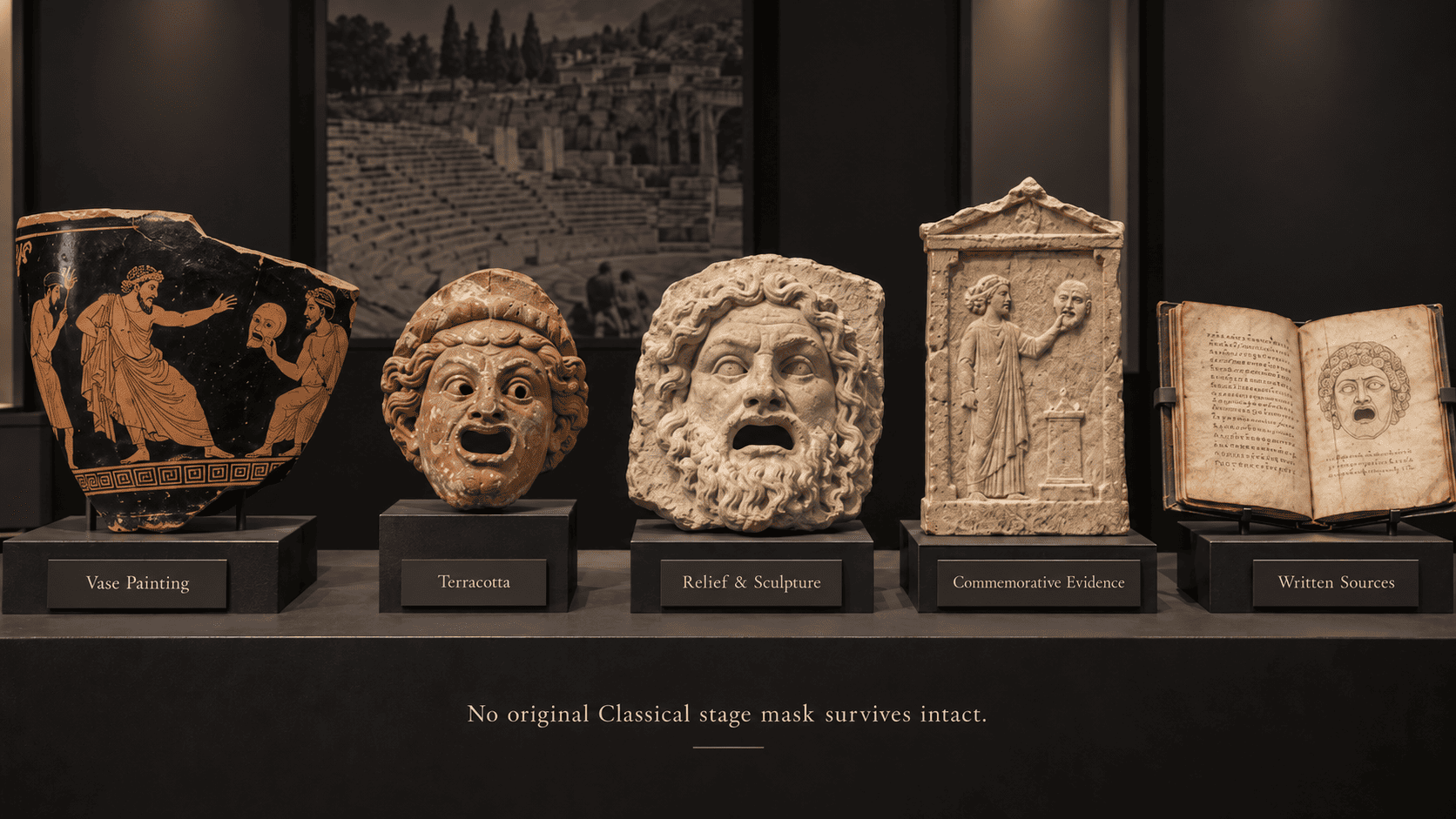
Lightweight organic materials decay. For that reason, no securely identified original Greek stage mask used in a Classical dramatic performance survives intact. Museum collections contain many terracotta, stone, or metal objects shaped like theatrical masks, but these may be models, votive offerings, decorations, architectural ornaments, or later representations rather than wearable masks once used by actors.
How Do We Know What Greek Theatre Masks Looked Like?
Historians reconstruct Greek theater masks by comparing several kinds of evidence rather than relying on a surviving stage mask. Each source answers different questions and has different limitations.
Vase Paintings and the Pronomos Vase
Vase paintings are especially valuable because some show performers in clearly theatrical settings. The late fifth-century BCE Pronomos Vase is one of the most important examples. It depicts members of a theatrical company associated with a satyr play, including actors and chorus members together with masks and costumes. Because some performers hold their masks rather than wear them, the image provides rare evidence for the relationship between the performer’s body, costume, and theatrical face.
Terracotta Models, Reliefs, and Decorative Masks
Terracotta figurines preserve comic and tragic character types, while reliefs, sculpture, and decorative masks show how theatrical faces were represented in later Greek culture. Many of these objects are too small, heavy, solid, fragile, or otherwise unsuitable for actual performance, so a terracotta “theater mask” in a museum should not automatically be described as a mask once worn onstage.
Written Sources and the Limits of Pollux
The second-century CE writer Julius Pollux preserved a detailed classification of theatrical mask types in his Onomasticon. Scholars compare his categories with surviving figurines and other visual evidence to identify recurring tragic and comic character types.
Pollux, however, wrote centuries after the fifth-century BCE playwrights. His catalog is valuable evidence for later theatrical conventions, not a direct inventory of masks used in the first performances of Sophocles or Aristophanes. Where written and archaeological evidence overlap, they can strengthen an interpretation; where they differ, the discrepancy may reflect changes in theatrical practice over time.
| Evidence | What It Can Tell Us | Main Limitation |
|---|---|---|
| Vase paintings | Actors, chorus, costumes, masks, and performance context | Artistic representation rather than surviving equipment |
| Terracotta figures and mask models | Character types and later visual conventions | Usually not wearable stage masks |
| Reliefs and sculpture | Theatrical iconography and recognizable mask forms | Often decorative or later than Classical performance |
| Written sources | Terminology, roles, traditions, and classifications | Some were written centuries after the Classical period |
What Do Greek Theatre Masks Symbolize Today?
The two familiar theater faces are commonly called the comedy and tragedy masks. The smiling face represents comedy and the sorrowful face represents tragedy, and the pair is commonly associated with the Muses Thalia and Melpomene. Those names belong to the Muses, however, not to two standard masks that ancient actors simply switched between.
The modern emblem condenses a much more complex Greek theatrical tradition into two recognizable faces. Ancient performers used numerous character masks in tragedy, comedy, and satyr drama, as well as masks for the chorus. For the broader history and meaning of the happy and sad symbols, see our guide to theater masks.
Japanese Mask Meanings: History, Symbolism, and Traditional Types
Hannya Mask Meaning: Symbolism, Colors, and Cultural Legacy
Traditional Indian Masks: Meanings, Rituals & Traditions
Death Masks: History, Purpose, and Famous Examples

Kitsune Mask Meaning, History, and Symbolism in Japan
Scold’s Bridle: History, Use & How the Punishment Worked
Explore More Mask Stories 👇