Interesting Facts About Masks: 12 Surprising Stories
Masks have served remarkably different purposes across human history. Some of the oldest surviving examples are about 9,000 years old, a Venetian mask could force its wearer to remain silent, and Japanese Noh masks can appear to change expression without moving at all.
Masks have been used in theater, ritual, medicine, social satire, disguise, and even luxury fashion. These 12 interesting facts about masks reveal how one simple idea—covering or transforming the face—developed in very different ways around the world. For more unusual stories and historical details, explore our collection of mask facts.
1. Some of the Oldest Known Masks Are About 9,000 Years Old
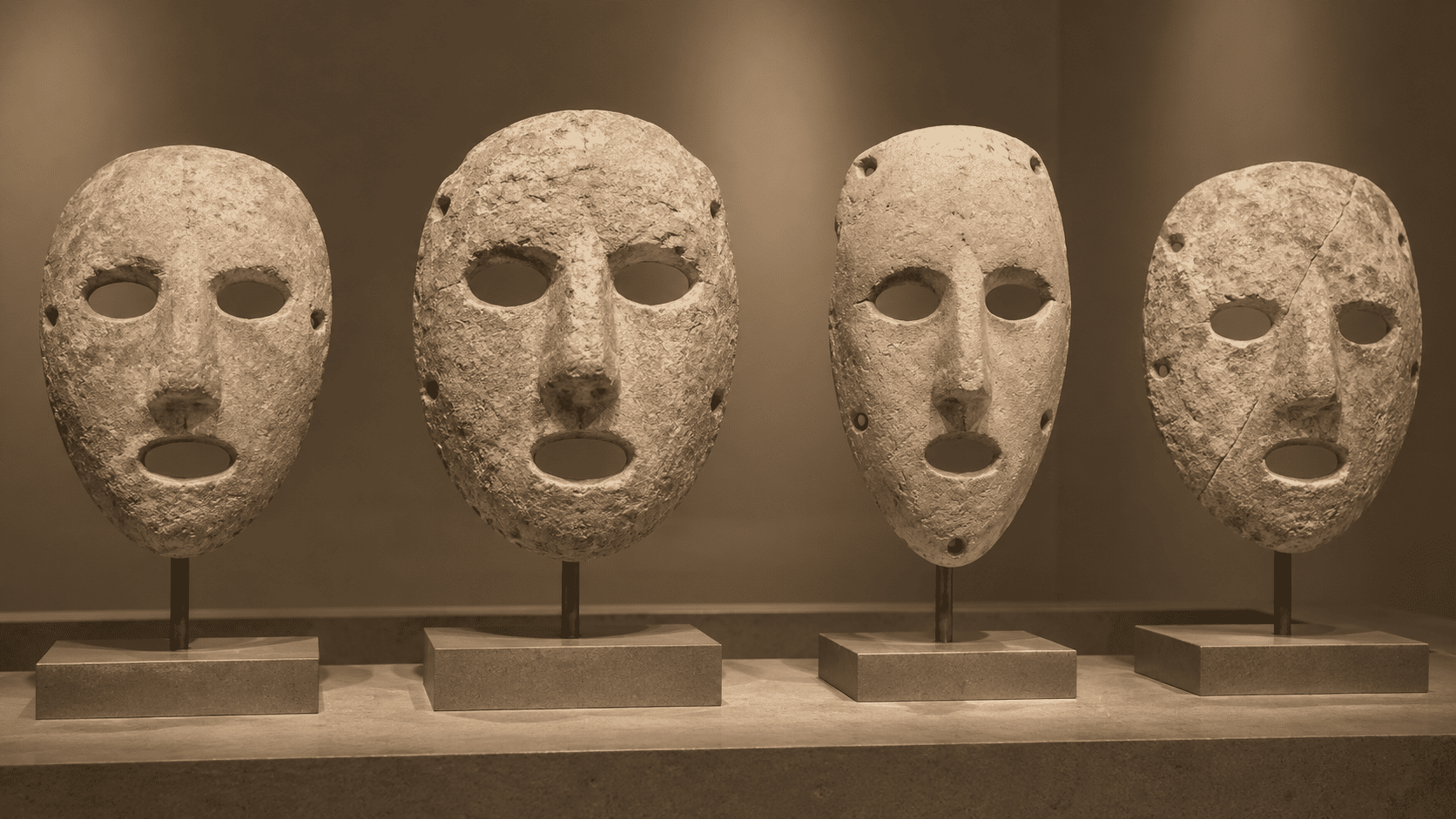
A remarkable group of stone masks dating to the Neolithic period is approximately 9,000 years old. The masks come from the region of present-day Israel and have hollow eye sockets, open mouths, and carefully shaped human features. They are among the oldest surviving masks known to archaeology.
Their exact purpose remains uncertain. Researchers have connected them with early ritual or belief systems, but there is not enough evidence to reconstruct precisely how they were used. That distinction is important: these ancient objects show that humans were creating mask-like representations thousands of years ago, but they do not tell us when masks were first invented or prove that all early masks served the same purpose.
2. Ancient Greek Theater Masks Were More Than Simple Disguises
Ancient Greek theater masks were an important part of performance, helping performers represent different characters and allowing an actor to assume identities very different from his own. Their exaggerated visual features also helped communicate characters to audiences watching from large outdoor theaters.
A popular story claims that Greek theatrical masks contained built-in megaphones—sometimes even described as brass devices inside the mouth—to amplify the actor’s voice. That should not be treated as established historical fact. Modern acoustic experiments suggest that reconstructed masks can affect how a voice radiates and sounds, but the precise construction and acoustic properties of ancient masks remain uncertain. The real history is more interesting than the simplified “ancient loudspeaker” story.
3. A Venetian Moretta Mask Was Held in Place With the Teeth
One of the most unusual Venetian masks was the moretta, an oval black velvet mask traditionally worn by women. Unlike masks secured with ribbons or straps, the moretta was held against the face by gripping a small button between the teeth.
The design had an extraordinary consequence: the wearer could not easily speak while keeping the mask in place. Her voice was concealed along with her face. During Venetian Carnival, masks could also reduce visible distinctions between social classes and give participants a degree of anonymity. The moretta took that idea even further by temporarily hiding both identity and speech.
4. Noh Masks Can Appear to Change Expression Without Moving
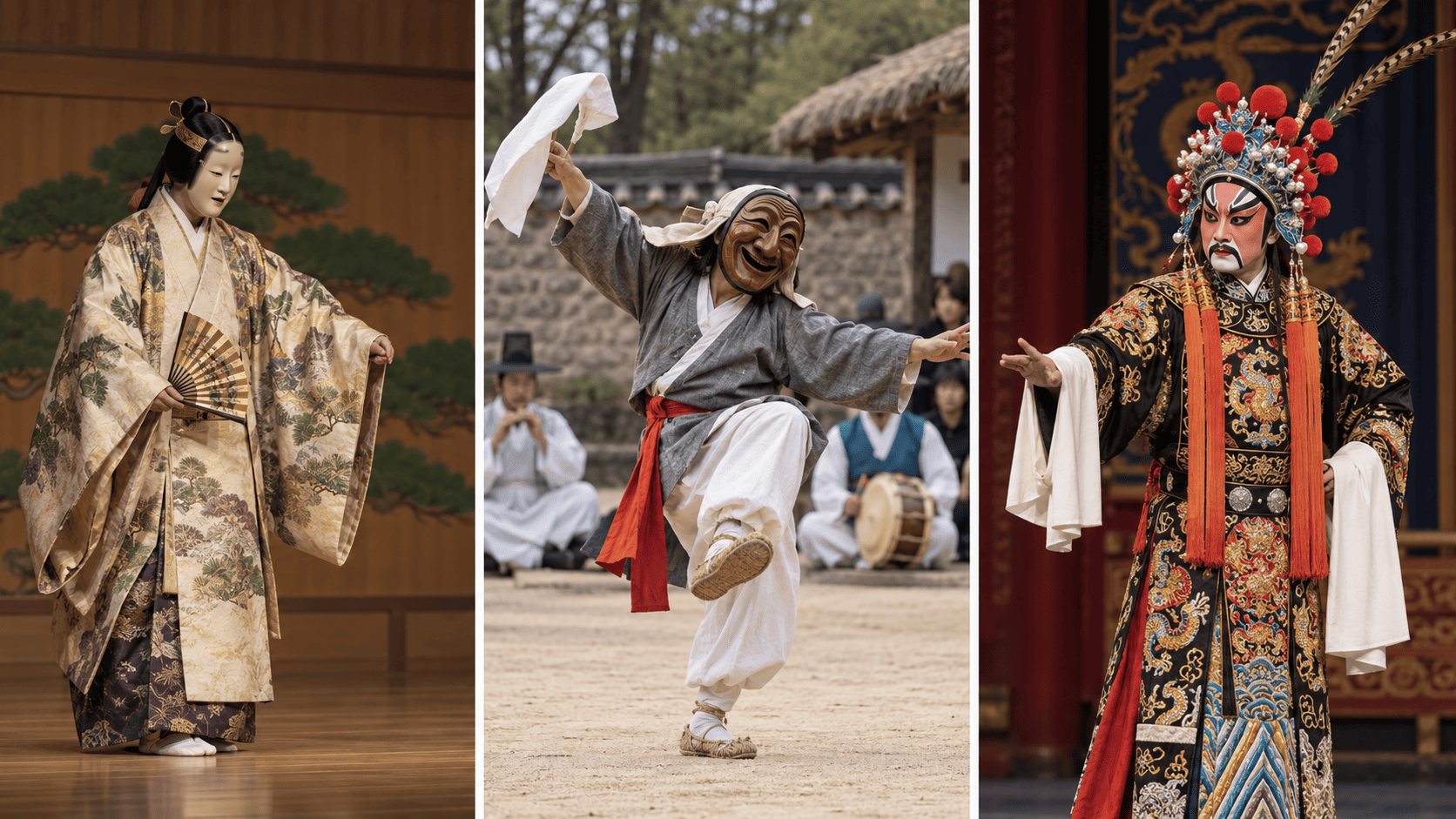
Japanese Noh masks do not need mechanical parts to appear emotionally different. The effect comes from a combination of the mask’s carefully carved features, the actor’s movements, the viewing angle, and the way light falls across its surface.
By tilting the head slightly upward or downward, a skilled performer can make the same fixed face appear lighter, darker, calmer, happier, or more sorrowful to the audience. This subtle control is one of the defining techniques of Noh performance. The mask itself remains physically unchanged; what changes is how the audience perceives its expression. It is an elegant example of how mask design and performance technique work together.
5. Korean Mask Dance Was Also a Form of Social Satire
Korean traditional masks were not always used in solemn or religious settings. Talchum combines masks with dance, music, theater, dialogue, and humor, and performers have used caricature to comment on society and criticize social hierarchy.
Characters can represent recognizable social types, and the audience is not necessarily passive: cheers, jeers, and interaction can become part of the performance. This makes Talchum as much a form of social commentary and public entertainment as a display of traditional masks. UNESCO inscribed Talchum on the Representative List of the Intangible Cultural Heritage of Humanity in 2022, recognizing a living performance tradition that continues in modern Korea.
6. Some Famous “Chinese Opera Masks” Are Actually Painted Faces
The brightly colored faces associated with Peking Opera are frequently called “Chinese opera masks,” but many of the best-known designs are not physical masks at all. They are elaborate patterns of makeup painted directly onto the performer’s face.
This painted-face tradition is especially important for jing roles and also appears in forms associated with chou characters. Patterns and colors help audiences recognize aspects of a character’s personality, status, or dramatic role. Physical masks also exist within broader Chinese mask traditions, but they should not be confused with Peking Opera’s lianpu facial makeup. What looks like a removable mask in a photograph may actually be painstakingly applied paint.
7. Not Every African Masquerade Was Performed by Men
Many documented African masks and masquerade traditions historically assigned performance roles primarily to men, which has led to the misleading assumption that women never wore traditional masks. The Sande Society of Sierra Leone and Liberia provides an important counterexample.
Among the Mende and neighboring peoples, women of the Sande Society perform with helmet masks commonly known as Sowei. These masquerades have been associated with female initiation, social identity, leadership, and other important ceremonies. The example is especially useful because it shows why broad rules about “African masks” often fail: masking practices differ significantly between societies, including in who is permitted to perform them.
8. The Plague Doctor Mask Was Protective Gear Before It Became an Icon
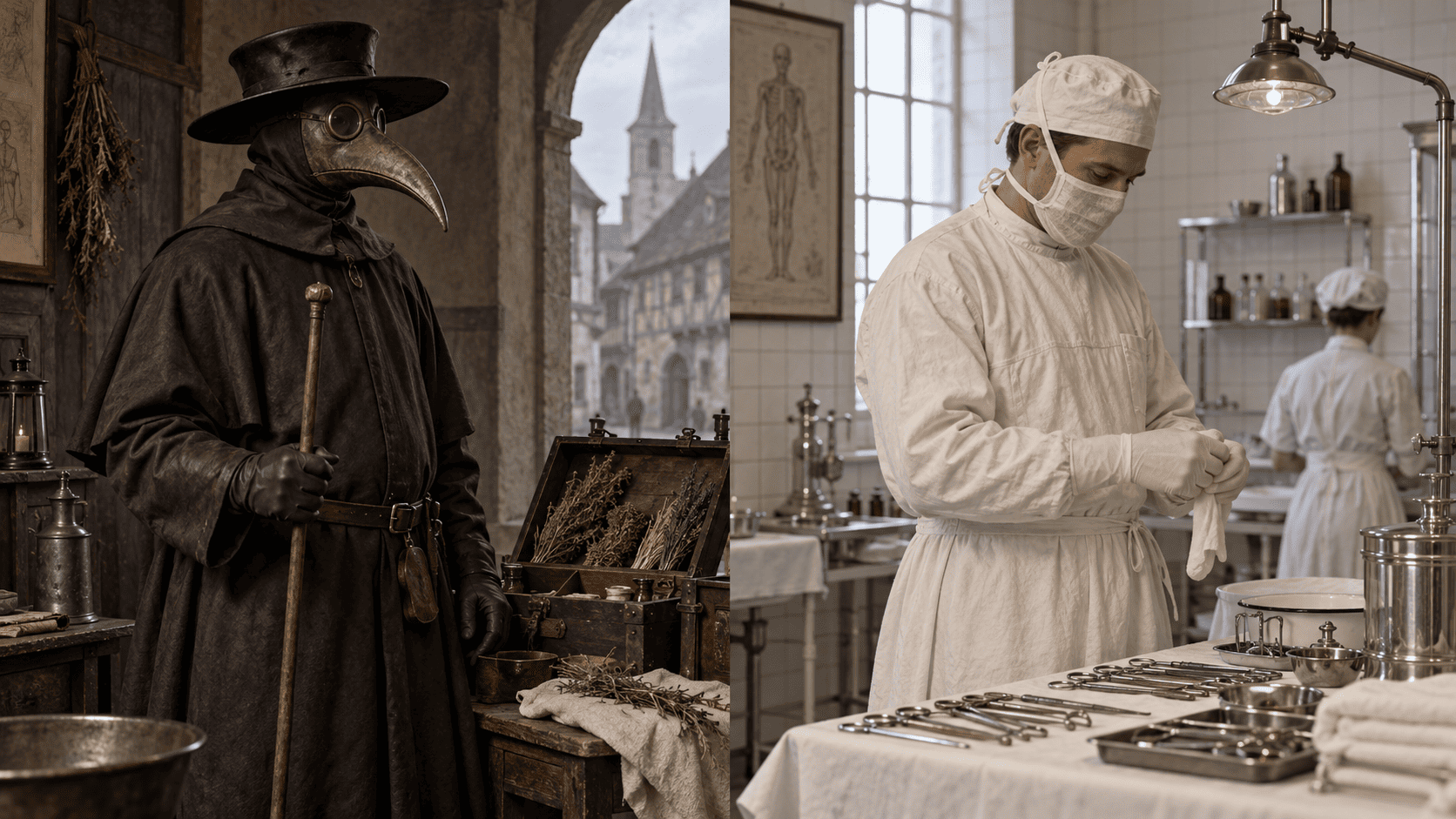
The familiar plague doctor with a long bird-like beak is now associated with Carnival costumes, Halloween, and horror imagery, but the historical design was intended as protective equipment. Versions of the beaked costume became associated with plague physicians in seventeenth-century Europe.
The beak could be filled with aromatic herbs and other scented substances. At the time, many people believed diseases such as plague could spread through poisonous or corrupted air—a theory known as miasma. The aromatic contents were therefore intended to protect the wearer from dangerous air. The idea was medically incorrect, but the distinctive silhouette survived long after miasma theory disappeared and eventually became one of history’s most recognizable masks.
9. Modern Surgical Masks Did Not Have a Single Inventor
The modern medical mask is sometimes credited to one surgeon, but its development was more gradual. During the late nineteenth century, new knowledge about bacteria and respiratory droplets changed how surgeons thought about infection.
In 1897, surgeon Johannes Mikulicz used a piece of gauze over his nose and mouth after bacteriologist Carl Flügge demonstrated that microorganisms could be carried in droplets from the human respiratory tract. French surgeon Paul Berger adopted a similar face covering around the same period. Rather than a single moment of invention, the surgical mask emerged from changing ideas about germs, sterile surgery, and protecting patients from microorganisms released by medical staff.
10. Some Masks Were Never Meant to Be Worn by a Living Performer
We usually imagine a mask as something placed over a living person’s face, but that definition does not fit every object called a mask. Funerary masks were created for the dead, while death masks were made to preserve the facial appearance of someone after death.
Ancient Egyptian funerary masks are among the most famous examples of masks associated with burial rather than performance. In later European traditions, a death mask could be produced by taking a mold or cast of the deceased person’s face, creating a three-dimensional record that artists and sculptors could later consult. These objects demonstrate that masks have also served remembrance, portraiture, and funerary purposes—not just disguise.
11. A Diamond-Covered Face Mask Was Valued at $1.5 Million
During the COVID-19 pandemic, Israeli jewelry company Yvel created an extraordinary face covering valued at approximately $1.5 million. It was made from about 250 grams of 18-karat gold and set with more than 3,600 natural black and white diamonds.
Despite its appearance as a piece of luxury jewelry, the design included space for a replaceable N99 filter. The mask was commissioned for a private client and required a team of artisans and diamond setters to complete. It is an extreme example of how an object normally associated with health and practical protection can also become a display of craftsmanship, wealth, fashion, and personal identity.
12. A Mask Can Hide One Identity While Creating Another
One of the most interesting things about masks is that concealment is only half of what they do. Covering a face can hide an ordinary identity while simultaneously creating a new one that may be even more recognizable.
That principle appears in very different settings. A Venetian Carnival mask could make the wearer anonymous, a theatrical mask could turn an actor into a specific character, and modern superhero or horror masks can create fictional identities recognizable around the world. In ritual and ceremonial traditions, the transformation can have an entirely different cultural meaning. Across these contexts, the mask does more than hide a face: it changes what the face communicates to everyone who sees it.
Explore More Mask Stories 👇